
The Multifunctionality of Ductile Iron Grating: Public Safety and Architectural Design
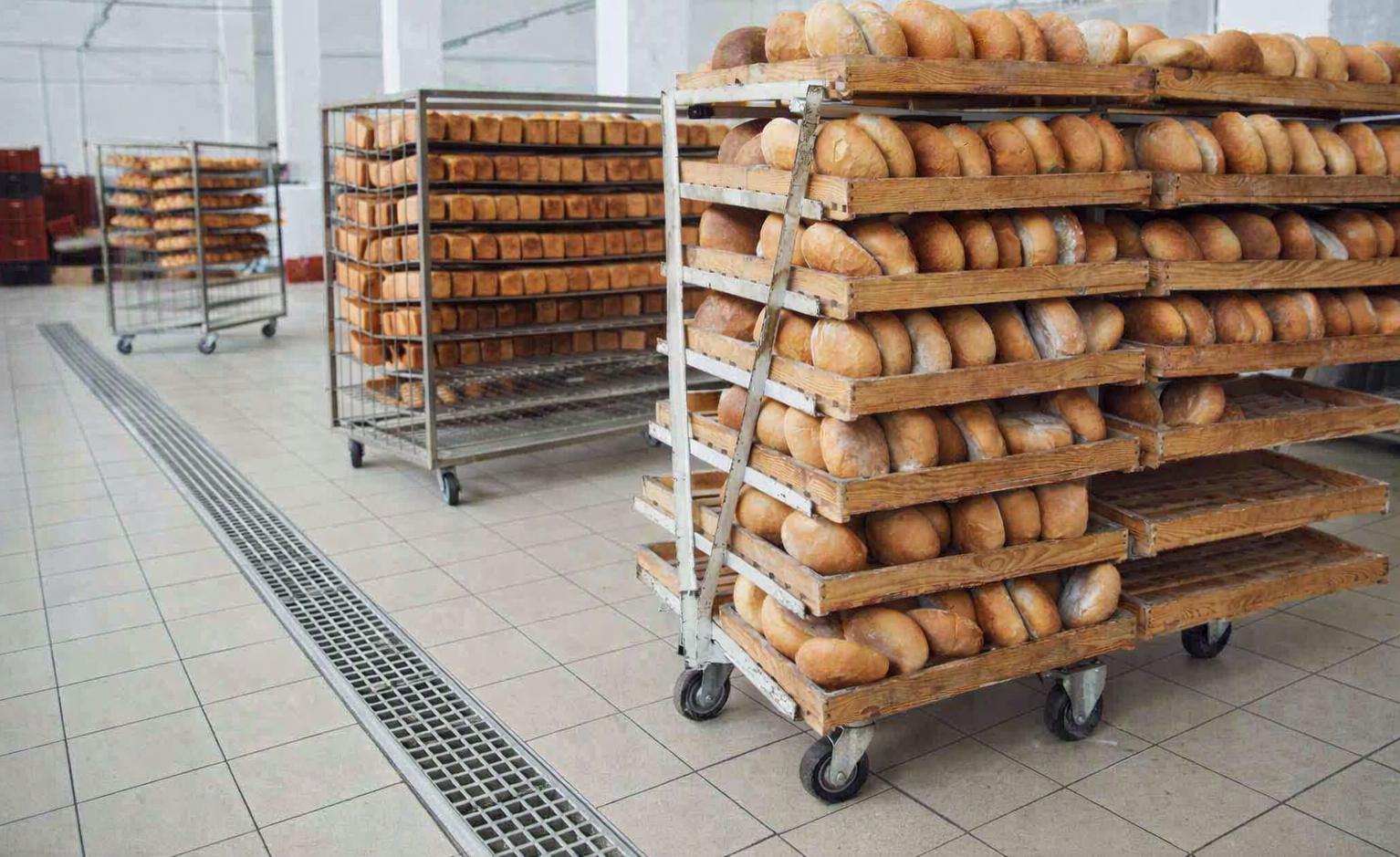
Although a D400 drainage grating can withstand roadway traffic, it may not be suitable for use on a pedestrian plaza. Wide slots can trap bicycle tires; an uneven frame creates a trip hazard; and standing water can remain if the inlet is not large enough.

The Multifunctionality of Ductile Iron Grating consists in making competing demands work together within a single drainage element, for example, the requirement to resist structural loads, to provide adequate hydraulic capacity, and to address the safety of pedestrians and architectural concerns.
In CMSA, choosing a grating is based on the installation environment, rather than the load class of the grating.
Ductile Iron‘s Combination of Strength and Design Flexibility
Nodular Graphite and Load Resistance
In comparison to Gray Cast Iron, Ductile Iron contains spheroidal graphite particles that reduce stress concentration, and improve its ductility and resistance to brittle fracture. Actual mechanical properties of Ductile Iron depend on the material grade specified.
Performance of ductile iron grating depends on four structural variables, and one manufacturing variable:
• Rib Depth and Thickness: Influence local bending resistance, and material distribution
• Unsupported span: Influence bending stress and deflection under wheel loads
• Opening geometry: control drainage access and continuity of load bearing ribs
• Frame contact: Transfer loads to the channel structure
Reducing the width of load bearing ribs to increase the opening of the grating may compromise the strength of the grating. Therefore the multifunctionality of ductile iron grating depends on its geometry and balance with mechanical resistance.
Which Grating Configuration Fits the Project?
Different materials and configurations solve different engineering problems.
| Design Option | Technical Consideration | Preferred Application |
| Ductile iron vs. gray cast iron | Higher ductility and fracture resistance | Repeated wheel loading |
| Ductile iron vs. stainless steel | Structural design, corrosion protection, weight, and finish | Heavy traffic versus corrosion-sensitive architectural areas |
| Narrow vs. wide slots | Pedestrian accessibility versus potential inlet area | Walkways versus drainage-intensive zones |
| Locked vs. removable grating | Retention security versus maintenance convenience | Traffic lanes versus controlled-access areas |
| Linear vs. point drainage | Continuous interception versus localized collection | Large paved areas versus isolated low points |
These alternatives demonstrate why a single grating design cannot satisfy every site condition.
Load Classification: Why F900 Is Not Always Necessary
EN 1433 defines classes of linear drainage systems by standardized test loads.
| Load Class | Test Load | Typical Location |
| A15 | 15 kN | Pedestrian and Cycling Areas |
| B125 | 125 kN | Footways and Light-Duty Vehicle Parking |
| C250 | 250 kN | Kerbside Drainage |
| D400 | 400 kN | Roadways and All-Duty Vehicles |
| E600 | 600 kN | Industrial Loading Areas |
| F900 | 900 kN | Aircraft Pavements |
The test loads shown do not correlate to admissible vehicle loads.
Larger test load classes do not necessarily mean greater drainage capacities. Consider wheel contact geometry, frequency of traffic and support conditions, as well as the grate and surrounding channel body and supports.
Drainage Capacity is Not Always Related to Slot Width
Effective Open Area vs Hydraulic Capture
Because ductile iron grates are multifunctional, a differentiation between geometrical and real open area is necessary.
Water interception is governed by:
• The orientation of the Slots: Determines how water on the surface flows onto the grate.
• Gradient: Speed and depth of water flowing on the surface.
• Distribution of Openings: Determines local hydraulic resistances and accumulation of debris.
• Capacity of Downstream Drainage: If the downstream drainage is filled, the intercepted water will back up.
The hydraulic assessment should also include design rainfall and the area of the catchment drained by the channel.
Pedestrian and Bicycle Safety
In accessible public spaces, slot geometry must account for wheelchair casters, walking aids, and bicycle tires.
For example, ADA Section 302.3 generally restricts surface openings on accessible routes to those that cannot admit a sphere larger than 13 mm. Elongated openings must be perpendicular to the dominant travel direction.
Local accessibility requirements should be checked separately from drainage load classifications.
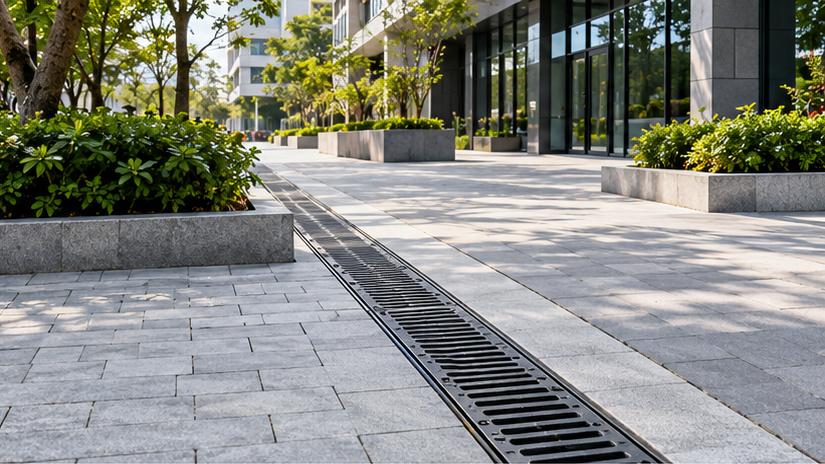
Incorporating Design While Meeting Safety Requirements
Decorative surface patterns can integrate drains in stone paving, pedestrian streets, and commercial landscape designs. Visual continuity should not override engineering requirements.
There are three design checks that should be addressed:
• Slip resistance: Texture of the pattern should be such that it provides sufficient slip resistance and is evaluated for the worst case scenarios of wetness and contaminants on the surface.
• Flush installation: Frame elevation should be such that it provides a level plane with the adjacent paving.
• Structural continuity: The decorative openings should retain load bearing ribs.
Coatings present another trade off. Anti-rust coatings may control moisture-related corrosion of the iron, but abrasion and road salts may cause the coating to flake off, and the edges may not be finished properly.
Coating selection should be such that it accommodates the environment and is acceptable to the maintenance staff.
Grating Failures Start During Installation and Maintenance
Although a grating may be properly specified, it can still rattle, shift, or fracture if the frame is poorly installed.
Critical Installation Checks
• Check frame and bearing surfaces to ensure they are of the correct size and are compatible with the grating channel.
• Ensure that the lateral supports are incorporated as specified, and that the prescribed bedding of concrete is done as specified.
• Review finished elevation and grating seating prior to opening to traffic.
• Identify potential retention or locking devices to address displacement.
Prioritize Maintenance
As part of a normal inspection, blockages and sediment build-up in drainage systems may be apparent. Restraint systems may be loose or coating damage may be evident. Movement at frame connections may also be seen.
A loose grating may be caused by deterioration of the supporting structure.
Standard and Documentation for Purchase
Prior to purchase of ductile iron grating, determine which of the following apply:
• EN 1433: Classification of prefabricated linear drainage channels
• EN 124: Gully tops and manhole tops, as applicable to product.
• EN 1563: Spheroidal graphite cast iron
• Local requirements: Openings and transitions in levels. Pedestrian safety.
Procurement documents should include evidence of load testing, grade of the material, drawings, locking details, and installation instructions.
CMSA Ductile Iron Grating: From Specification to Site Compatibility
CMSA supplies the MEA ductile iron grating, Model 11A295, for integration into engineered drainage systems.
| Product Detail | CMSA Model 11A295 |
| Material | Ductile iron |
| Grating width | 122 mm |
| Load classification | Up to F900 |
| Referenced standard | EN 1433 |
| Compatible channel series | EN1000, U1000, Z1000, LZ1000/80 |
| Surface protection | Anti-rust coating options |
| Retention | Locking mechanism options |
The F900 capability must be confirmed for the specific configuration and installation arrangement.
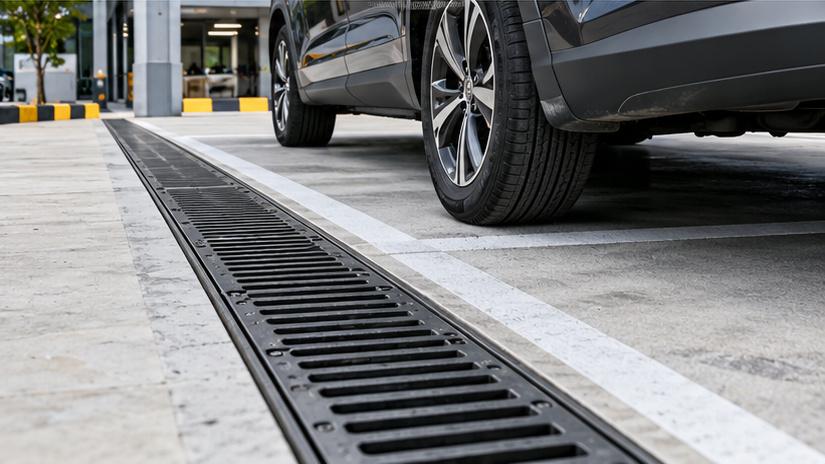
For architects and contractors, The Multifunctionality of Ductile Iron Grating becomes useful when the grating is selected together with its channel, traffic exposure, drainage requirements, and surface design.
CMSA can help project teams review these compatibility requirements before procurement. Explore our MEA Ductile Iron Grating specifications and discuss the appropriate configuration for your drainage project.
FAQs
Q1. What Is the Multifunctionality of Ductile Iron Grating?
The multifunctionality of ductile iron grating refers to its combined roles in load resistance, surface drainage, pedestrian safety, and architectural integration. CMSA offers ductile iron grating configurations for different infrastructure applications.
Q2. What Load Class Does CMSA Ductile Iron Grating Support?
CMSA’s MEA ductile iron grating is listed with load classifications up to F900 under EN 1433. The required class must be verified for the selected grating and channel assembly.
Q3. Is CMSA Ductile Iron Grating Suitable for Public Roads?
Yes. CMSA offers ductile iron grating for road drainage applications. Engineers should select the appropriate load class based on traffic conditions, channel compatibility, and installation requirements.
Q4. Which Drainage Channels Are Compatible with CMSA Ductile Iron Grating?
CMSA offers compatibility with MEA EN1000, U1000, Z1000, and LZ1000/80 channel systems. Specific dimensions and installation details should be confirmed before ordering.
Q5. How Does CMSA Ductile Iron Grating Support Pedestrian Safety?CMSA offers different slot configurations that can be evaluated for pedestrian areas. Opening dimensions, surface transitions, and slip resistance must be checked against applicable accessibility requirements.
Share on Social:


