
Why TopSlot Drain for Public Infrastructure Fits Modern Urban Developments
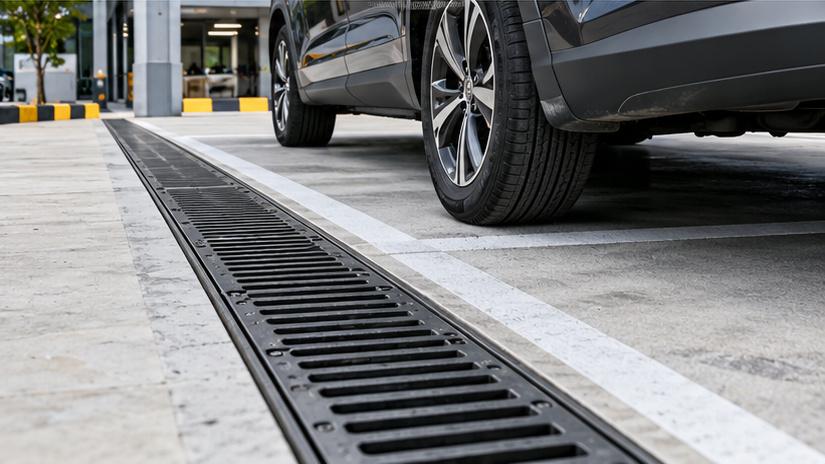
A public plaza may have sufficient underground drainage capacity and still experience surface ponding. Runoff may bypass an inlet, poorly coordinated paving levels may divert water away from it, or sediment may obstruct the opening. Replacing a conventional trench grate with a discreet slot therefore requires more than an architectural decision.

At CMSA, we assess a TopSlot Drain for Public Infrastructure through the complete drainage path—surface interception, channel conveyance, outlet capacity, structural loading, and maintenance access.
Why Public Plazas Need More Than a Discreet Drainage Line
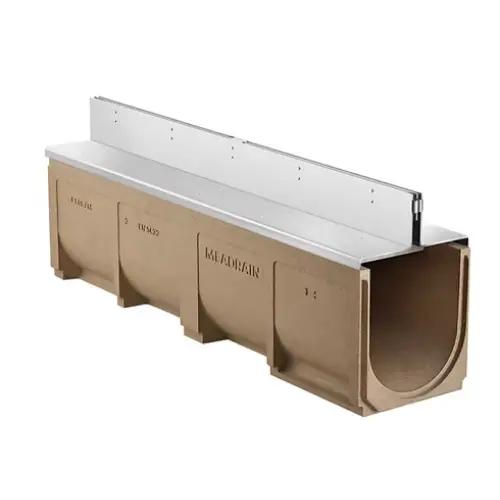
Traditional grated channels provide a broad, accessible inlet but can interrupt continuous stone or concrete finishes. MEA TopSlot leaves a narrow visible opening above a concealed drainage channel, making it suitable for consideration in plazas, building perimeters, pedestrian walkways, and landscaped boundaries.
That benefit depends on surface grading. A visually unobtrusive slot positioned outside the actual runoff path will collect little water. Pavement crossfall and longitudinal gradient must direct runoff toward the opening, particularly around entrance thresholds and changes in paving slope.
How Slot Interception and Channel Capacity Differ
A TopSlot Drain for Public Infrastructure has three distinct hydraulic limitations:Inlet interception: How much approaching runoff enters the surface opening rather than bypassing it.
• Channel conveyance: How much collected water the underground channel transports at the available depth and gradient.
• Outlet discharge: How much flow the downstream connection accepts without causing backwater.
MEA TopSlot accommodates channel clear widths of 100–300 mm. These dimensions describe the underground channel, not the visible slot opening.
What Should Engineers Calculate?
Start with design runoff based on rainfall criteria and runoff characteristics, and then evaluate:
• Slot interception under the proposed crossfall and longitudinal gradient.
• Channel conveyance using an appropriate hydraulic method, i.e. Manning’s equation.
• Flow accumulation along the channel and required outlet spacing.
• Tailwater, sediment accumulation, and stormwater overflows.
Increasing channel size will not address inadequate surface interception. Similarly, a well placed slot will not address flooding due to an undersized outlet system.

Center, Side, or Multiple Slots: Which Arrangement Fits the Paving?
The preferred slot position follows the runoff path, not simply the paving pattern.
| Drainage arrangement | Suitable application | Critical design check |
| Center slot | Drainage lines within paved areas | Crossfall and interception from intended sides |
| Side slot | Façade edges and paving boundaries | Wall junctions, waterproofing, and inlet positioning |
| Multiple slots | Locations requiring additional inlet openings | Effective capture area and structural configuration |
| Arc slot | Curved plazas and landscaped surfaces | Joint alignment and fabrication details |
| Conventional grate or point drain | Debris-heavy areas or isolated low points | Inlet capture and cleaning accessibility |
Multiple slots do not automatically double captured flow. A conventional grated channel may also be preferable where leaf litter is substantial or frequent full-width cleaning access is necessary.
Matching TopSlot Dimensions, Traffic Loads, and Pavement Levels
Selecting a TopSlot Drain for Public Infrastructure requires hydraulic dimensions and structural loading to be evaluated separately.
CMSA provides the following MEA TopSlot options:
| Specification | Engineering consideration |
| 100–300 mm channel clear width | Design flow, invert depth, and outlet restrictions |
| Multiple channel body heights | Available installation depth and gradients |
| 1.2, 2, or 3 mm cover thickness | Structural configuration and loading requirements |
| Loading class up to D400 | Actual traffic exposure and approved installation |
| Customizable slot height | Paving thickness and finished surface levels |
| Stainless steel 304/316 options | Environmental exposure and corrosion resistance |
Does a Pedestrian Area Need D400?
Not necessarily. Public squares may carry only pedestrians during normal operation but accommodate cleaning trucks, delivery vehicles, or emergency access.
Under EN 1433, D400 represents a 400 kN test-load classification, not a permissible total vehicle weight. Cover thickness alone does not establish compliance. The channel, slot cover, supporting structure, and installation conditions must be considered together.
For coastal or chloride-exposed environments, stainless steel 316 generally offers greater resistance to localized corrosion than 304. However, material grade does not eliminate the need for appropriate joint detailing and maintenance.
Preventing Pavement Damage and Sediment Buildup
Most TopSlot installation problems originate at interfaces rather than along an uninterrupted channel section.
Finished Levels and Structural Support
Specify the manufactured slot height against the actual paving build-up. Before installation, confirm:
• Bedding and concrete encasement requirements for the selected load class.
• Support beneath adjacent stone or concrete paving edges.
• Movement joints, channel connections, and outlet positions.
• Surface level tolerances that prevent ponding beside the slot.
Poorly supported stone edges can chip under concentrated loads. Incorrect finished levels may also prevent runoff from entering the opening.
Access for Inspection and Cleaning
A concealed drainage system still receives sand, leaves, and litter. Although MEA TopSlot provides removable-cover access, cleaning arrangements must be considered during layout design.
Plan inspection locations for bends, low points and outlets, as appropriate. Location of debris collection should dictate cleaning interval rather than assume self-cleaning.

Verifying EN 1433 Loading and Pedestrian Accessibility
For a TopSlot Drain for Public Infrastructure, project approval should be based on documentation for the specified configuration.
EN 1433 covers classification, testing, marking and compliance with regards to drainage channels. Classification of load does not define the hydraulic capacity or accessibility in compliance with the standard.
For public accessible routes in the US, ADA Section 302.3 details the minimum dimensions of ground openings and the orientation of elongated openings. Different standards may be imposed by other jurisdictions.
• Load-test documentation and approved installation details should be verified by engineers.
• Hydraulic calculations and outlet compatibility should also be verified by engineers.
• Slot dimensions, surface transitions and accessibility should also be verified.
• Engineers should also verify material specifications and relevant inspection records.
Final Words
CMSA provides assistance with drainage projects by evaluating hydraulic capacity of drainage systems, selecting products, preparing layouts and providing BIM resources and installation aids. Explore our MEA TopSlot Drainage solutions and contact us to describe your project to have a TopSlot Drain for Public Infrastructure designed specifically to your site conditions.
FAQs
Q1. What Is a TopSlot Drain for Public Infrastructure?
A TopSlot Drain for Public Infrastructure is a concealed linear drainage system that collects surface runoff through a narrow slot above an underground channel. CMSA offers MEA TopSlot solutions for plazas, pedestrian areas, and building perimeters.
Q2. What Channel Widths Does CMSA Offer for TopSlot Drainage?
CMSA offers MEA TopSlot channel clear widths from 100 mm to 300 mm. The appropriate width depends on design runoff, channel depth, gradient, and outlet capacity.
Q3. Can CMSA TopSlot Drainage Support D400 Loading?
Yes. MEA TopSlot configurations are available with loading classes up to D400 under EN 1433. The specified assembly and installation must be verified for the project’s traffic conditions.
Q4. Which TopSlot Configurations Are Available from CMSA?
CMSA offers center, side, single, multiple, and arc slot configurations. Selection depends on pavement geometry, runoff direction, architectural requirements, and installation constraints.
Q5. Can CMSA Customize TopSlot Height and Cover Thickness?
Yes. CMSA offers customizable slot heights and cover thickness options of 1.2 mm, 2 mm, and 3 mm. The configuration must match finished pavement levels and structural requirements.


