
Linear Drains for Outdoor Areas: Patios, Pools, and Landscaped Spaces
For patios and pool decks, along with their adjacent landscaped areas, to last, effective water management is essential. Traditionally, point drains capture water in a way that is often the cause of ponding, staining, and even structural failure. Out of the three, linear drains, which capture water in a continuous fashion, are more efficient and easier to install and are less visually obtrusive. This article discusses the technology and materials behind Linear Drain Systems. It further highlights their applications and the sustainability and durability of polymer concrete.

1. What are Linear Drains? Components and Function
Linear Drain Systems are composed of three components:
•Channel body: This component makes up the bulk of the system. It channels water to where it is needed the most. These need to be durable to the physical and chemical environment. Most channel bodies are made of stainless steel, polymer concrete, or plastic.
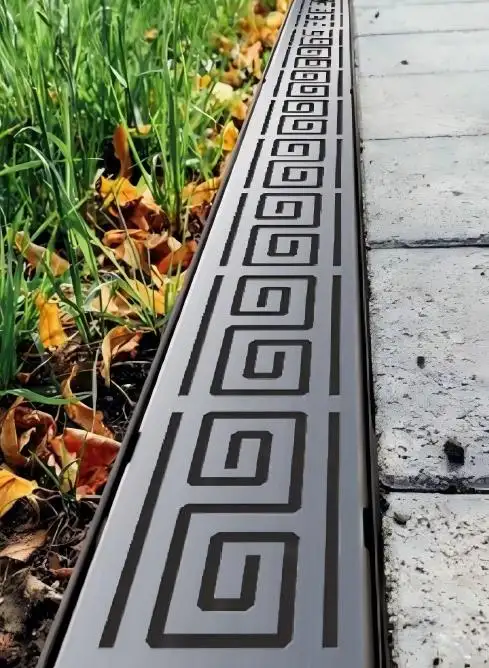
•Grate or cover: This component is the most visible of the System. It channels water and keeps debris from entering the channel. It is made in different configurations and material.
•Outlet connector: The conduit that connects the channel to the system of drainage pipes.
Unlike point drains that need a four way slope to a low point, Linear Drains utilize a one way slope system, which can be more efficient. This design also greatly simplifies the need for grading and piping. It also allows large paving materials to be used and simplifies the need for cutting.
2. Linear Drains vs. Point Drains: A Comparison
The table below differentiates between Linear Drains and point drains.
| Feature | Point Drains | Linear Drains |
| Slope requirement | All four directions to a single low point | One direction to the channel |
| Water capture area | Limited to the area near the grate | Continuous along the channel |
| Installation complexity | High, because of the many slopes and pipe connections | Low, because of the simple grading and few outlets |
| Ponding risk | High, especially with large/irregular areas | Low, from constant interception |
| Aesthetic Impact | Multiple visible grates disrupt paving patterns | Discrete and often flush with minimal visual disruption |
| Maintenance access | Multiple points to be inspected | Central, with channel and grate removal |
| Cost-effectiveness | Elaborate piping Labor and material costs | Length of time, fittings, and labor are reduced |
There is an obvious interest in Linear Drains from residential patios to commercial plazas.
3. The Material Advantage: Linear Drains and Polymer Concrete
The channel body is the most critical element in Linear Drains, and the best systems use the best materials. Polymer Concrete is an excellent material for the most demanding environments.
High-quality polymer concrete is used by high-end manufacturers like CMSA in Linear Drains. The following offer some of its technical advantages:
| Properties of High-Quality Linear Drains | Benefits for Outdoor Drainage |
| High Mechanical Strength | Linear Drains retain integrity under heavy pedestrian and vehicular traffic. |
| Chemical Resistance | Linear Drains are resistant to de-icing salts, fuels, oils, and pool chemicals (Chlorine and Bromine). |
| Low Water Absorption | Linear Drains are protected from freeze-thaw in cold climates and avoid internal corrosion. |
| Wear and Maintenance Free | Linear Drains smooth, dense surface is resistant to abrasion with no need for sealing or coating. |
| Modular and Lightweight | The drains are easy to handle, transport, and install. It also lessens the demand for cranes or heavy lifting equipment. |
| Recyclable | After the linear drain reaches the end of its useful life, it can be ground up and used again to enable a circular economy. |
| Groundwater Protection | Linear Drains provide reliable capture and conveyance of runoff, preventing contamination of soil. |
| Various Fall Possibilities | Linear Drains can be supplied to meet site requirements with integral slope or installed at a site with fall. |
With all these advantages, flexible modular polymer concrete Linear Drains are an intelligent application for chemical exposure that also considers the environment.
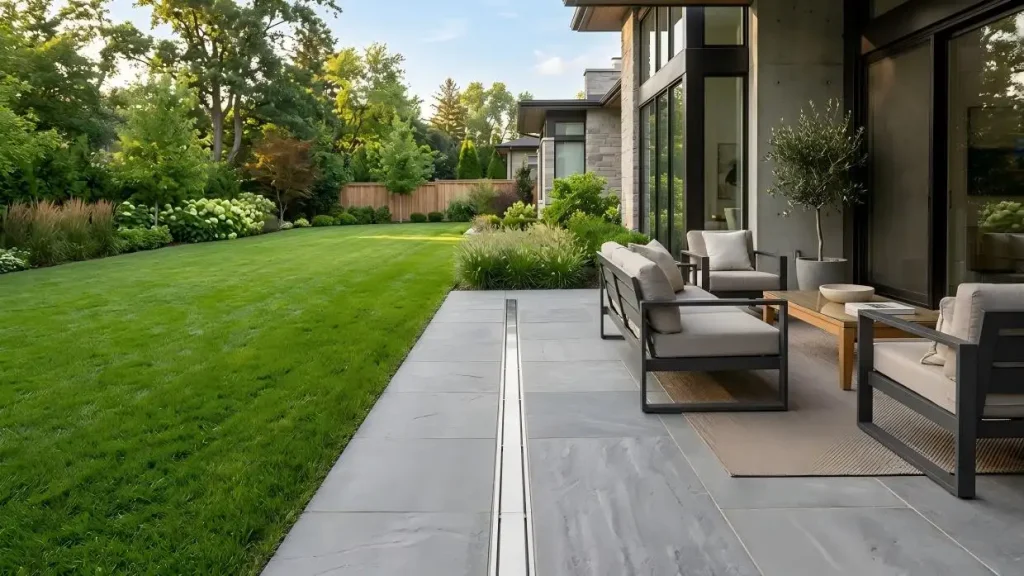
4. Application 1: Patios and Terrace Areas
The pooling of water on patios creates a safety and health hazard and damages the building. Linear Drains help solve the problems of edge drains located at the door thresholds. Specifically:
•Design flexibility: Linear Drains give designers the option to set thresholds drains at the building edge and thus create a more integrated design.
•Safety: Eliminating pooling water reduces the risk of slipping.
•Building protection: Linear Drains divert water so it doesn't reach building thresholds and seep into the foundation.
•Paving Time: the Single-slope design allows large, single, square paving to be set.
5. Application 2: Pool Decks and Surrounds
Pools and their decks pose even more difficult drainage problems: water splashing from swimming, heavy foot traffic, and exposure to harsh chemicals. Linear Drains are ideal pool surrounds because of:
•Capturing Water: Slip prevention and pest attraction are solved by Linear Drains' ability to collect splashed and rained water.
•Chemicals: Linear Drains' polymer concrete construction will not erode from pool and deck chemicals and will last structurally intact for decades.
•Self Cleaning: Optimized hydraulics in Linear Drains' design carry the debris away and reduce the need to clean.
•Durability: Quality Linear Drain Systems achieve a heavy load class (D400), accommodating even the heaviest vehicular traffic.
•Design: Linear Drains' versatility in grate design (slot, heel-safe, decorative, etc.) means they can serve any modern design requirement.
6. Application 3: Landscaped Spaces and Garden Areas
In finished, garden areas with irrigation, Linear Drains deal with runoff from both Rain and active irrigation. This helps protect the site from soil erosion and helps maintain the hardscape and overall site integrity.
•Pathway edge drainage: Linear Drains are installed along garden walkways to capture runoff that would spill onto the paving, thus maintaining both the cleanliness and the safety of the garden walkways.
•Retaining wall toe drainage: Linear Drains are installed along the toe of retaining walls to relieve the build-up of water and the pressure behind the wall.
•Transition zones: Linear Drains, installed along the edges of lawns and patios or driveways, provide a neat and functional edge for the diversion of water from both the permeable and impermeable surfaces.
•Groundwater quality: Because Linear Drains intercept runoff prior to soil infiltration, fertilizers, pesticides, and organic matter will not leach into groundwater. This provides a valuable environmental advantage.
7. Design and Installation for Linear Drain Systems
Engineers and contractors must consider the following for effective Linear Drain systems.
| Design Parameter | Consideration |
| Hydraulic capacity | Should be calculated for optimum peak flow for a given rainfall intensity, catchment area, and runoff coefficient. |
| Channel slope | Minimum 0.5% gradient to maintain self-cleaning velocity; integral slope channels simplify installation. |
| Load class | Select grate and channel strength according to expected traffic (pedestrian, light vehicle, heavy truck). |
| Outlet position | End outlet, centre outlet, or vertical outlet—affects pipe routing and hydraulic efficiency. |
| Grate type | Slot, mesh, or solid cover; consider heel-safety for barefoot areas and anti-slip surface treatment. |
| Material compatibility | Ensure channel, grate, and fasteners are compatible with site chemicals (salt, chlorine, fertilisers). |
| Expansion joints | Provide appropriate gaps between channel and paving to accommodate thermal movement. |
| Inlet protection | Use debris baskets or sediment traps if falling leaves or grit are expected. |
Leading suppliers like CMSA provide engineering support and system design aid including CADs, BIM, and hydraulic calculations.
8. Advantages of Polymer Concrete Linear Drains
Linear Drains are the ideal choice for drainage systems due to their sustainable, long term solution:
•Durability: Longer than 50 years less replacement and new material usage.
•Recycled: Can be made into new products.
•Pollution Control: Safeguard aquifers from avoidable pollution.
•Maintenance: Saves money on water, chemicals, and labor.
•Corrosion control: Watertight joints allow for full drainage of channels.
Conclusions
Linear Drains have become the industry standard for drainage in patios, pools, and landscaping. They offer great flexibility in design, and great hydraulics and are fully polymer concrete.
Plastics have great chemical and mechanical properties, and linear drains offer the following:
•Pollution control through plastic and protection of groundwater.
•Complete Structural and Chemical integrity.
•A fully sustainable system with virtually no maintenance.
With climate change and new codes becoming more stringent, now is the time to invest in Linear Drains to provide beautiful outdoor solutions.
FAQs
Q: What are the main differences between Linear Drains and standard point drains?
A: Point drains require multiple slopes and grading, while Linear Drains only require one slope and capture water continuously.
Q: Can Linear Drains be installed in areas that experience vehicle traffic?
A: Yes, as long as the appropriate load classes are specified (A15 for pedestrians, and up to D400 for heavy vehicles). .
Q: What is the best material for a drain that is going to be installed outdoors and need a long life?
A: Polymer concrete has the best strength and the best resistance to chemically based cleaners, has low absorption, and requires low maintenance.
Q: Are Linear Drains made of polymer concrete recyclable?
A: Yes, in the spirit of the circular economy, the concrete can be crushed and reused.
Q: Is there an environmental benefit to using Linear Drains?
A: They help keep polluted water from getting into the groundwater and decrease the need for cleaners, which in turn decreases the use of chemicals.


