
Sewage Lift Station Construction: The Complete Guide to Holding Tank Size and Pump Capacity
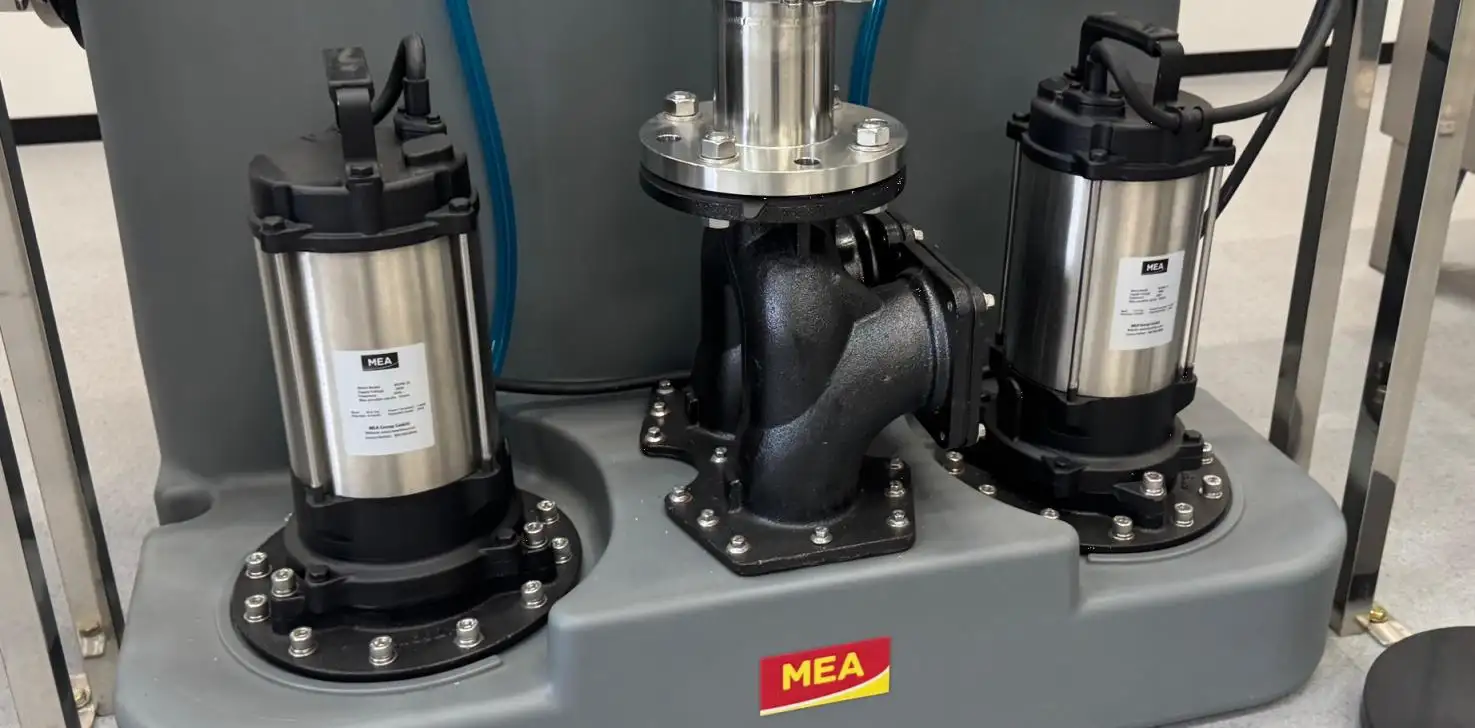
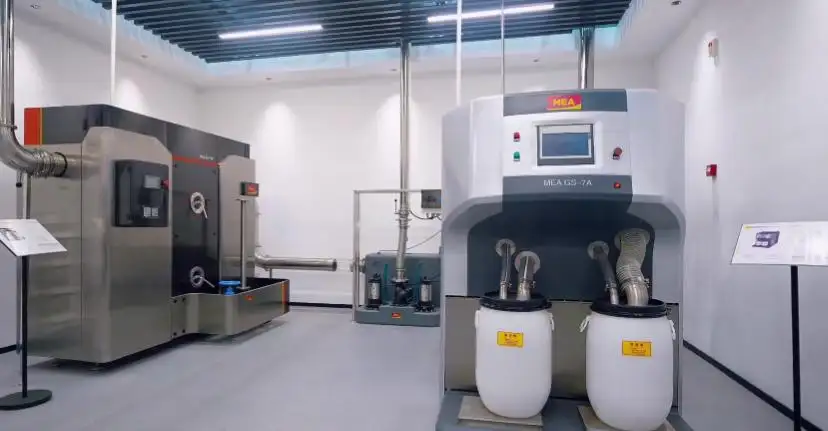
Gravity might be unable to transport your wastewater to the nearby permanent sewer line in some remote settings. In this case, a sewage lift station would be the best option. Consider a lift station when finishing a basement, adding a below-grade bathroom, or building a commercial kitchen. In these three cases, learn how to properly size the pump and the lift station's holding tank. The following steps engage you in the critical choices presented when constructing sewage lift stations and demonstrate some of the specialized advantages of CMSA's Steady-Blauwal line.
Why Construction of Sewage Lift Stations is Important
A septic or municipal system receives waste pumped by a sewage lift station out of a watertight tank after being collected. Sizing is important as there are consequences resulting from inadequate sizing:
• Tanks and pumps can overflow.
• Motors can be burned from short cycling.
• Pumps can become clogged by the solids that exceed the pump's capabilities.
The smart controls, corrosion resistance, and dual-pump redundancy that are typical features of modern sewage lift station construction, when combined, are reflected in CMSA's Steady-Blauwal.
How to Size a Sewage Holding Tank
Tank capacity is in gallons or liters. For residential and light commercial applications, the rule of thumb is: the tank should hold at least 24 hours of average wastewater flow – though local codes may vary.
Key Factors to Calculate Tank Volume
| Factor | Guideline |
| Number of fixtures | Each toilet, sink, shower, or floor drain adds flow |
| Occupancy or meal count | Residential: 50–70 gallons/person/day; Commercial kitchen: 5–10 gallons/meal |
| Pump cycle frequency | Pumps should run 4–6 times per hour maximum |
| Solids handling | Tanks must allow solids to settle before pumping |
Simple Calculation Example
For a household of 4 people:
• Average daily flow: 4 × 60 gallons = 240 gallons (≈ 900 liters)
• Desired retention: 240 gallons ÷ 6 cycles/hour = 40 gallons per cycle
• Minimum tank size: 40–50 gallons (150–190 liters) – which matches CMSA's standard 150L tank.
CMSA's Steady-Blauwal 150 series features a 150L HDPE tank – ideal for most homes, basement bathrooms, and small kitchens. For larger loads, the Steady-Blauwal 500 series offers a 500L tank.
When to Go Bigger
• Multiple washing machines or dishwashers
• Commercial kitchens with high grease content
• Buildings with peak-hour events (restaurants, churches, gyms)
How to Decide Pump Capacity (Flow Rate & Head)
Step 1: Calculating Maximum Flow Rate
The maximum flow rate in the system is approximated by calculating the maximum flow rate of all the fixtures happening simultaneously. Below are some standard flow rates of the fixtures:
• Toilet: 5 to 10 GPM
• Shower: 3 to 5 GPM
• Kitchen Sink: 4 GPM
• Dish Washer: 2 GPM
Given the values, an approximate flow of 12 GPM can be used for a bathroom with a toilet, a shower, and a sink.
Step 2: Total Dynamic Head (TDH)
TDH is the sum of the vertical lift (in feet) and the friction losses (in feet).
Measure the distance from the discharge tank to the outlet of the discharge pipe to determine vertical lift.
Friction loss = 5–10% of vertical lift for short runs; more for long horizontal pipes.
Example: Lift = 15 feet, horizontal run = 50 feet → friction ≈ 5 feet → TDH = 20 feet.
Step 3: Match Pump to Duty Point
Compare your TDH to the pump's performance curve. For most home applications, a 1.5–2.2 kW pump handles 15–25 feet TDH at 40–80 L/min.
CMSA's Steady-Blauwal 150-15/22/30 offers three power options:
• 1.5 kW – for single-family homes with 10–15 ft lift
• 2.2 kW – for duplexes or light commercial with 20 ft lift
• 3.0 kW – for restaurants or multi-fixture basements up to 30 ft lift
All operate at 2950 RPM with a non-blocking channel and metal impeller – essential for handling kitchen grease and domestic solids.
CMSA's Design and Technical Advantages in Sewage Lift Station Construction
CMSA has engineered the Steady-Blauwal series to solve the three most common pain points: clogs, corrosion, and control failures.
Unmatched Protection: IP68 Enclosure
The pump's fully sealed IP68 rating allows continuous submersion without risk of water ingress. Unlike cheaper units with IP54 or IP67, IP68 means you can install directly in the tank's wet well – no separate dry pit required.
Intelligent Control – Air Pressure & Liquid Level
Traditional float switches stick or tangle. CMSA uses dual sensing: air pressure and liquid level control. This provides:
• No moving parts in the wastewater
• Accurate start/stop cycles
• Prevents dry running and overflow
Non-Blocking Metal Impeller
The large-channel, ductile iron impeller shreds and passes solids up to 2 inches (∅110 mm inlet). Compared to plastic impellers, metal resists abrasion from sand, grit, and fibrous debris – extending pump life by years.
Dual-Pump Redundancy
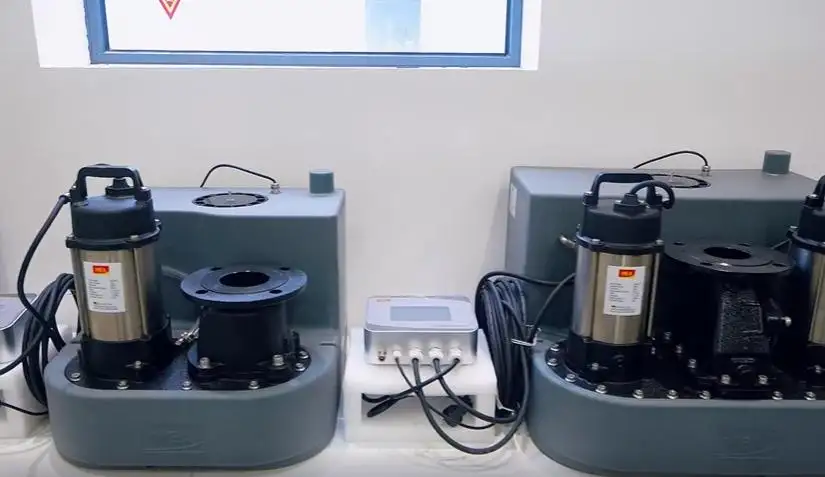
Every Steady-Blauwal model comes as a double pump system. If one pump fails or cannot keep up during peak flow, the second pump activates automatically. A control cabinet (pre-wired) manages alternating cycles, equalizing wear.
Multiple Water Inlets – Flexibility in Installation
The tank accepts connections from several sources (kitchen sink, washing machine, floor drain, toilet) via multiple inlets. This make the construction of a sewage lift station in confined locations like crawl space or utility closets easier.
| Feature | Benefit |
| HDPE Tank | Light, Corrosion Resistant, and Easy to transport |
| Ductile Iron Pump Body | High Pressure and Impact Resistant |
| SiC Mechanical Seal | High Temperature and Chemical Resistant |
| SUS304 Fastenings | No Rust in Acidic Waste Water |
Putting It All Together: Choosing Your CMSA Steady-Blauwal Model
Refer to this selection guide:
| Application | Recommended Model | Tank Size | Pump Power | Peak Flow Capacity |
| Basement Bathroom (1 toilet + 1 sink) | Steady-Blauwal 150-15 | 150L | 1.5 kW | 40 L/min @ 15 ft |
| Small Apartment or Small Kitchen | Steady-Blauwal 150-22 | 150L | 2.2 kW | 60 L/min @ 20 ft |
| Kitchen of Restaurant with 2 Bathrooms | Steady-Blauwal 150-30 | 150L | 3.0 kW | 80 L/min @ 25 ft |
| Light Commercial (cafe + laundry) | Steady-Blauwal 500-30/40 | 500L | 3.0–4.0 kW | 100 L/min @ 30 ft |
| Multi-Unit Residential | Steady-Blauwal 500-55/75 | 500L | 5.5–7.5 kW | 150 L/min @ 40 ft |
Always add a 20% safety margin to your calculated flow and head. Also consider derating for underground and high temp applications.
Final Steps Validation for an accurate sewage lift Station
Check the following criteria before purchasing a lift station.
1. Tank Size = Peak Daily Flow / Desired Daily Cycles (Target 4 to 6 cycles/hour).
2. Pump head rating = TDH + 10%
3. Impeller = non-blocking/metal (not plastic vortex)
4. Enclosure = submersible, rated IP68
5. Control system = air pressure + liquid level (float switches = inadequate)
6. If basement space is rented out, install two pumps (no failures allowed)
7. For a corrosion-resistant and cost-effective solution, install a CMSA lift station (tank constructed of HDPE)
Conclusion
Sizing sewage holding tanks and pumps correctly saves property owners costly drain backups and their associated inconvenient drains. Start by calculating daily flow and total dynamic head, then select a tank that buffers peak loads and a pump that delivers at least 20% more capacity than required.
CMSA's design and technical advantages – especially the IP68 enclosure, metal impeller, and dual-sensing controls – make the Steady-Blauwal series a standout choice in sewage lift station construction. Whether you need the compact 150L for a home basement or the powerful 500L for a commercial kitchen, CMSA provides reliable, clog-resistant operation backed by smart engineering.
Request a quote from CMSA today, and ensure your wastewater always flows uphill – without trouble.
Frequently Asked Questions (FAQ)
Q1: Can I use a single pump instead of a dual-pump system?
A: Yes, but dual-pump systems (like all CMSA Steady-Blauwal models) provide redundancy. An automatic backup pump is engaged when a primary pump is unable to handle full capacity or fails. The flooding, as well as costly downtime, is prevented.
Q2: What are the options if my tank is too small?
A: An undersized tank causes the pump to cycle on and off too frequently (short cycling), which overheats the motor, wastes energy, and drastically shortens pump life. Always follow the 4–6 cycles per hour rule.
Q3: How do I know if the metal impeller is necessary?
A: If you discharge kitchen wastewater (with grease, food scraps) or any wastewater containing sand, wipes, or fibrous material, a metal impeller resists wear far better than plastic. CMSA's ductile iron impeller is non-blocking and lasts for decades.
Q4: What maintenance does a sewage lift station require?
A: Very little with CMSA's design. Check the control panel annually, test the dual-pump alternation, and remove any debris from the tank inlet screens. The IP68 enclosure and corrosion-resistant materials eliminate most routine service.
Q5: Is it possible to build the lift station outside?A: Correct. The HDPE tank is resistant to UV rays and is easy to carry. The CMSA pumps are rated IP68 and can be fully submerged, so outdoor underground pits work great. Just be sure the control cabinet is installed above grade in a weatherproof place.


