
Ductile Iron Grating Materials vs. General Iron: A Comprehensive Guide
In the selection of materials for industrial flooring, drainage covers, and heavy-duty access solutions, safety, durability, and long-term costs are greatly influenced by the material(s) used. Two of the commonly compared materials are Ductile Iron Grating Materials and general (most often gray cast) iron. Although these materials may appear similar, their internal structures and performance characteristics differ significantl. This article explores why Ductile Iron Grating Materials have become the gold standard in modern engineering, comparing them point by point with traditional general iron.
What Are Ductile Iron Grating Materials?
Ductile Iron Grating Materials are a modern class of cast iron that undergoes a unique nodularization process. By adding small amounts of magnesium or cerium during casting, the graphite flakes found in general iron transform into spherical (nodular) shapes. This seemingly minor change revolutionizes the metal's mechanical properties. Ductile Iron Grating Materials are widely used for trench grates, manhole covers, bridge drainage systems, and industrial walkways.
In general iron (gray cast iron), graphite is found in flaky form. Flakes are considered internal stress risers; therefore, they render the material brittle and susceptible to breaking.
Key Mechanical Variations
1. Tensile Strength and Load Capacity
•Ductile Iron Grating Materials: Tensile strength in ductile iron grating materials is between 60,000 and 120,000 psi (414–827 MPa). Therefore, grating materials will not fail with large vehicular (and truck) loads.
•General Iron: Their tensile strength is between 20,000 and 60,000 psi (138–414 MPa). Due to this, general iron grating is appropriate only for pedestrian loads.
Summary:
Ductile iron grating materials can handle high point loads. On the other hand, general iron grating will fail once the safe load is exceeded. Ductile Iron Grating Materials reduce the replacement frequency by 5–10×.
2. Elongation and Ductility
Ductility is the ability of a material to be stretched thin and/or elongated when pulled and the ability to undergo plastic deformation without rupturing.
•Ductile Iron Grating Materials: Have a minimum of 10–18% elongation. For this reason, grating will not fail and break, but will deform and indicate failure visually.
General Iron: This has elongation of almost 0% (<1%). Similar to glass, it breaks and fails by means of a brittle fracture without plastic deformation when subjected to an external force.
3. Impact Resistance
Ductile Iron Grating Materials: Shock and vibrations are dispersed efficiently. When a heavy object drops onto the grating material, it gets dimpled and does not break.
•General Iron: It breaks and fails upon impact. This explains the safety risks it has in an industrial area.
•Durability against Corrosion/Wear: Protective coatings are applied to both iron types to avoid rust. However, Ductile Iron Grating Materials have a definitive advantage when used in the field.
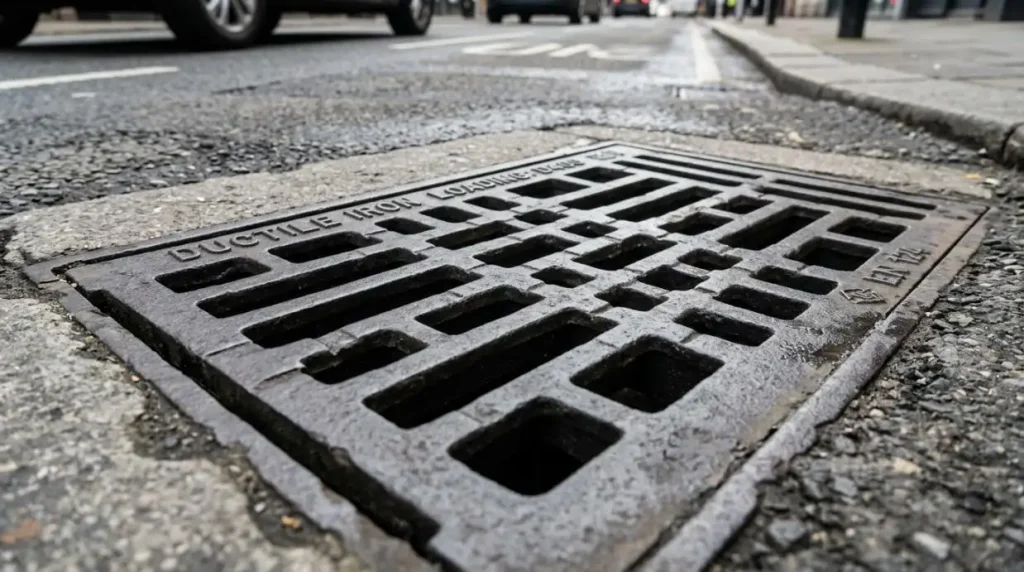
Ductile Iron Grating versus General Iron
| Feature | Ductile Iron Grating | General Iron |
| Uniform Microstructure | Yes – nodular graphite | No – flaky graphite |
| Corrosion Initiation sites | Fewer | Many (flake tips) |
| Coating adhesion | Excellent | Moderate |
| Service life in wet conditions | 25-50 years | 5-15 years |
Both Ductile Iron Grating and General Iron have different microstructures which affect their rusting. Ductile Iron Grating has a nodular structure which leads to less internal galvanic cells and can slow down rusting, while General Iron has a flaky structure which leads to the formation of capillary channels which can greatly increase rusting.
Weight and Installation Considerations
Ductile Iron Grating Materials can be cast with thinner cross sections than General Iron while achieving the same load rating. This means:
•20-30% lighter grates
•Less structural support
•Less labor time for install
However, General Iron is cheaper per pound. The engineers must consider the cost of the materials versus the cost of performance.
Fatigue Life and Repeated Loading
The industrial grates have millions of load cycles.
•Ductile Iron Grating Materials: Excellent fatigue strength (40-50% of ultimate tensile strength) withstanding millions of load cycles before crack initiation.
•General Iron: Very low fatigue limit (15-25% of ultimate tensile strength). Flake graphite tips lead to microcrack formation under repeated load cycles.
For high traffic areas (such as loading docks or aprons of airport), Ductile Iron Grating Materials are a must.
Cost Analysis: Short-Term vs. Long-Term
| Factors | Ductile Iron Grating | General Iron |
| Raw material cost | Higher (30-50% more) | Lower |
| Fabrication cost | Similar (sand casting) | Similar |
| Installation cost | Lower (lighter) | Higher (heavier) |
| Maintenance frequency | Every 20 years | Every 5 years |
| Replacement cost | Rare | Frequent |
| Total lifecycle cost (20 years) | Lower | Higher |
If used in municipal work or permanent infrastructure, Ductile Iron Grating Materials will be a long term saving to the taxpayer.
Where Ductile Iron Grating Materials Work Best
•Heavy vehicle access roads – 40 ton truck load capability
•Airport runways and taxiways – fatigue resistant
•Chemical plant and refinery – better impact and corrosion margin
•Cold climates – retains good ductility below -40 degrees centigrade (general iron can become brittle)
•Pedestrian areas in high theft zones – Ductile iron has low scrap value to steal, but general iron grates are stolen and recycled
Fabrication and Customization
Ductile Iron Grating Materials can be cast into more complex shapes, sharper edges, and thinner walls than general iron.
•Heel-safe slot designs (5mm openings)
•ADA-compliant surfaces
•Integrated locking mechanisms
•Custom logos or load ratings can be cast directly into the grate
General iron's poor fluidity in molten state limits intricate designs.
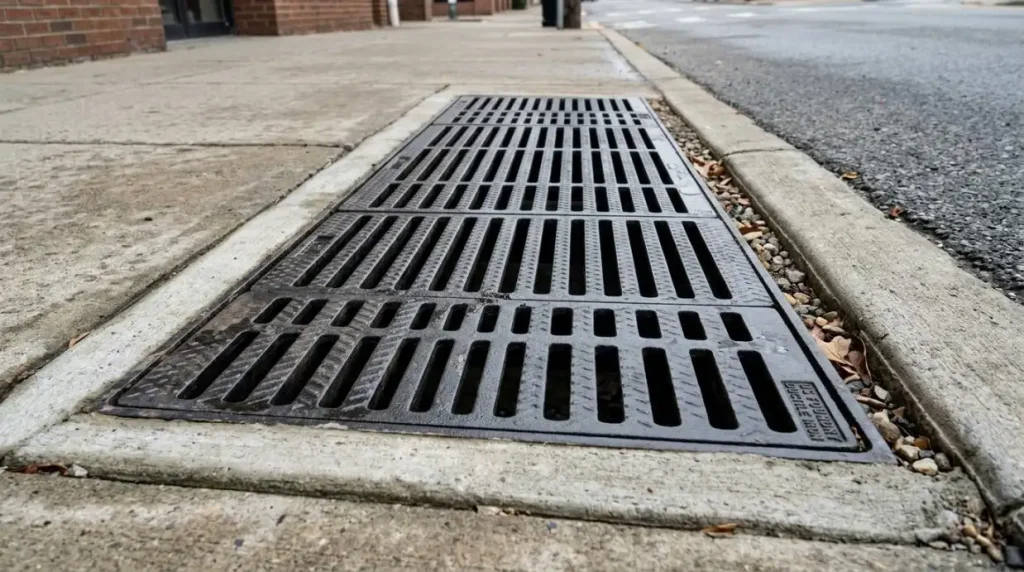
Safety Considerations
Ductile iron yields and deforms, general iron shatters. Shattered grates create dangerously sharp shrapnel. Both materials are non-combustible, but ductile iron can maintain strength at high temperatures better than general iron.
Slip resistance: Comparable when patterned – no inherent advantage for either.
Environmental Impact
CMSA Ductile Iron Grating is sustainable for several reasons:
•Raw material extraction is decreased due to a longer lifespan (3–5×)
•100% totally recyclable
•Less fuel is consumed to transport
•Less industrial waste occurs due to less replacements
Typical iron is replaced often, leading to an increased carbon footprint each usage.
CMSA Design and Corrosion Protection
General iron oxidizes extremely rapidly in contact with moisture, road salts, and chemicals. Without a coating, grey iron reaches rust at perceivable levels in a matter of months. Better ductile iron grating systems with CMSA design and technical advantages utilize several layers of anti-rust approaches.
• Bituminous or asphalt coating – A low-cost option for underground drainage that is not easily abraded.
• Zinc-aluminum alloy (Zn-Al) – Offers 3–5 times the corrosion life of standard HDG in salt spray tests.
By contrast, general iron products often receive only a thin paint layer or no coating at all, leading to rapid section loss and eventual structural failure.
Slot Width and Style Flexibility for Drainage Efficiency
The CMSA design and technical advantages also extend to hydraulic performance. Ductile iron grating materials can be cast with a wide range of slot geometries:
•Heel-safe slots (≤18 mm wide) – Prevent bicycle wheels or high heels from trapping, used in pedestrian zones.
•High-flow slots (30–50 mm) – For rapid stormwater removal on highways.
V• -shape or tapered slots – Self-cleaning design prevents debris from jamming.
•Continuous slots vs. punched holes – Depending on aesthetic and debris handling needs.
General iron products are rarely available in such variety due to casting limitations and low demand. A typical general iron grate offers only one or two fixed slot patterns.
Ductile Iron Grating (CMSA Series) vs. General Iron
Take the CMSA ductile iron grating (Model 11A295, 122 mm width) as an example. Its specifications embody the CMSA design and technical advantages:
| Feature | CMSA Ductile Iron Grating | General Iron (Gray/Cast) |
| Material | Ductile iron (spheroidal graphite) | Gray iron (flake graphite) |
| Anti-rust coating | Multiple options (HDG, epoxy, etc.) | None or thin paint |
| Load class | Up to F900 (90 tonnes) | Typically D400 or lower |
| Slot width variation | Yes – multiple styles | Very limited |
| Locking mechanism | Available (optional) | Rare |
| Compatibility | EN1000, U1000, Z1000, LZ1000/80 | Usually non-standard |
| Expected service life | 30–50 years | 5–15 years |
“A range of slot widths and styles are suitable for application scenarios with various drainage requirements.” – This flexibility allows a single product family to serve pedestrian plazas (heel-safe slots) and airport taxiways (high-flow slots) without changing channel systems.
Conclusion: Why Ductile Iron Grating Materials Win
General iron suits only light, static uses. Ductile Iron Grating Materials dominate for safety, durability, and long-term value due to their nodular graphite and fatigue resistance.
✅ Choose for loads >2.5 tons, cyclic traffic, cold or corrosive environments.
�� Use general iron only for temporary or pedestrian-only applications.
Steel is useless for engineers and infrastructure owners, mainly because of their anti-rust coatings, flexible systems, and F900 loading capacity.
FAQs
Q1. Is normal iron grating Ductile iron grating more expensive?
A. Compared to normal iron grating, Ductile iron grating costs more; however, economy-wise, it is worth it because of its service life, corrosion resistance, and minimal maintenance for the duration of its service life.
Q2. Does standard iron grating carry heavy truck traffic?
A. Standard iron grates can't do that, since they are brittle. Ductile iron grates, however, can handle repeated truck loads with an F900 or 90 tonne rating with ease.
Q3. Does ductile iron grates rust?
A. Ductile iron grates will rust if you treat them that way. After Hot dip galvanization and some epoxy coatings, they will be corrosion protected for decades.
Q4. What's the difference between ductile iron and standard iron?
A: Ductile iron will produce a lower, more dull sound during the ring test, while standard iron grates will produce a higher sound. Otherwise, look for certification.
Q5: Is ductile iron grating recyclable?A: Yes, ductile iron can be melted down and recast with no loss of mechanical integrity whatsoever.


