
Polymer Concrete Channel Drains vs Fiberglass Trench Drains: An In-Depth Technical Comparison
Engineers and contractors face a big decision when designing a system: do they choose a Polymer Concrete Channel system or fiberglass Trench drains? Choosing one system over another is not as straightforward as it seems. They both present benefits over cast-in-place concrete drains. It is important to look at the drains side by side and analyze performance, durability and life cycle expenses. This article focuses on the applications, trade-offs, and science of both options.
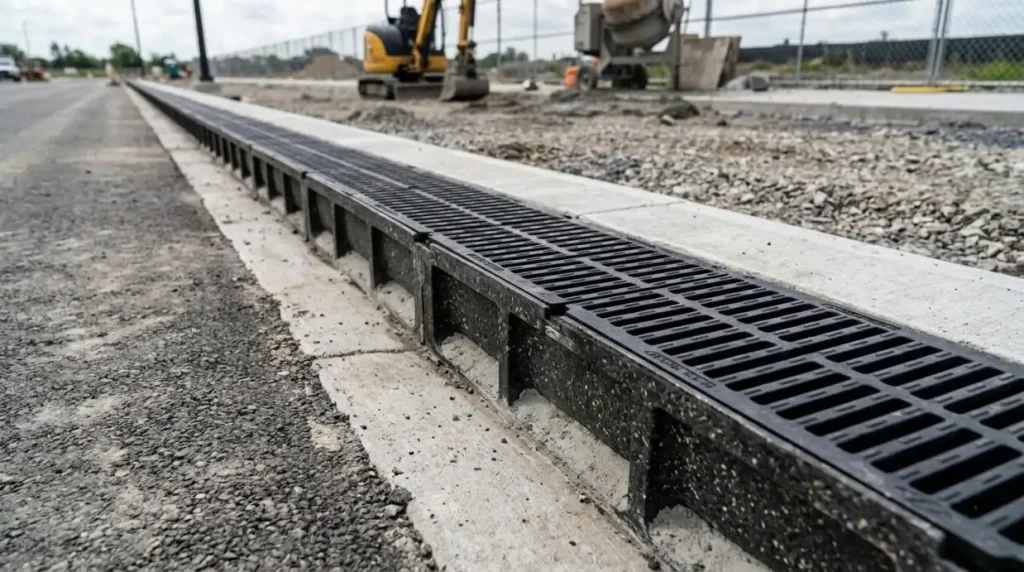
What Is a Polymer Concrete Channel Drain?
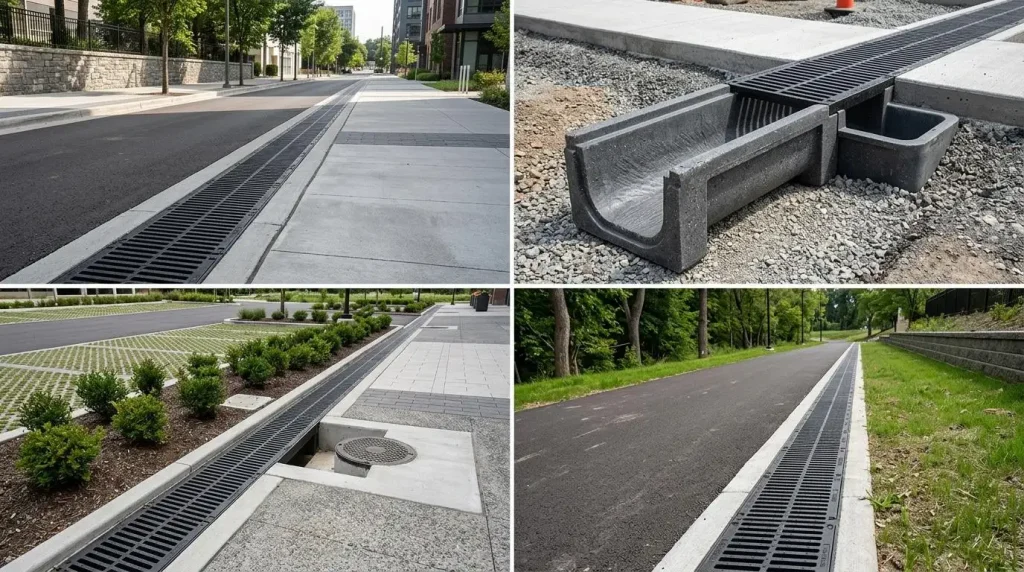
Polymer Concrete Channel drains replace the Portland cement used in concrete with a thermosetting polymer resin binding quartz, granite, or silica aggregates. The new material is dense, non-porous, ultra-strong, and resistant to many chemicals after curing (which occurs without moisture). Curing without moisture also prevents typical concrete shrinkage, which can lead to cracking.
A few of the unique features of Polymer Concrete Channel systems are:
• Very low water absorption (<0.1%) – no freeze-thaw issues
• High chemical resistance – not damaged by oils, acids, salts, and deicing materials
• Smooth surface – reduces friction, and channels drain and self-clean
• Light weight yet rigid – handles better than cast concrete
What Are Fiberglass Trench Drains?
Fiberglass Trench drains (also called FRP drains) are composites of glass fibers in a matrix of polyester, vinyl ester, or epoxy resin. Various manufacturing methods (e.g., hand lay-up, filament winding, or pultrusion methods) are used to facilitate the production of custom shapes in addition to an integrated grating system. Chemical and waste water management systems use fiberglass in parts of the system such as trench drains due to their resistance to corrosion effects.
Fiberglass trench drains:
1. Fiberglass trench drains can endure strong acids longer than some polymer concrete materials and metals.
2. Weigh less than polymer concrete trench drains.
3. Are safe for use in proximity of electrical and electronic systems.
4. Better than other rigid materials in support of point loads.
5. Support loads and are strong.
Head-to-Head Comparison: Performance Metrics
Structural Strength and Load Ratings
Relatively better stress distribution in trench drains is provided by polymer concrete than other materials. Fiberglass trench drains are strong enough in tension, but can sag with heavy loads. For forklift traffic or highway shoulders, Polymer Concrete Channel is the preferred choice.
Chemical Durability
Both materials resist corrosion better than steel or conventional concrete, but with different profiles:
• Polymer Concrete Channel performs exceptionally well against dilute acids, alkalis, salt solutions, fuels, and most organic solvents. However, concentrated strong acids (e.g., >30% sulfuric) may attack certain polymer binders.
• Fiberglass trench drains show superior resistance to strong acids and halogens but can be degraded by aromatic hydrocarbons or ketones.
• For food processing plants (moderate acids, frequent hot-water washing) – Polymer Concrete Channel is ideal. For chemical storage areas (concentrated hydrochloric acid) – fiberglass may be better.
Temperature Stability
Polymer Concrete Channel withstands continuous temperatures from -40°F to 250°F (-40°C to 120°C) with minimal expansion (coefficient ~7-12×10⁻⁶/°C). Fiberglass has a higher thermal expansion (15-30×10⁻⁶/°C) and begins to soften above 200°F (93°C) in polyester resins. In freeze-thaw cycles, the near-zero absorption of Polymer Concrete Channel eliminates spalling—a common failure in fiberglass if water infiltrates microscopic voids.
Installation and Labor Efficiency
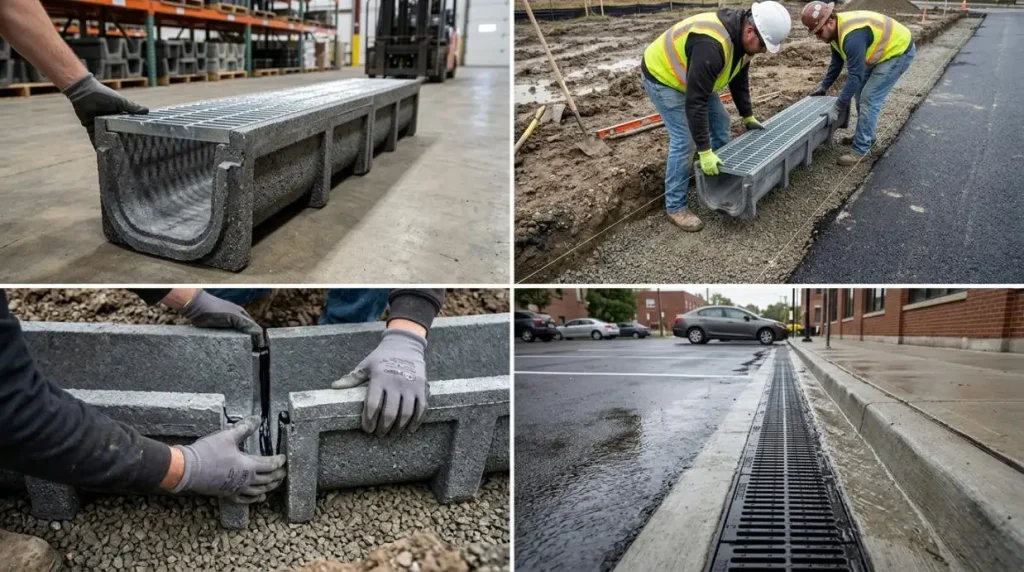
Polymer Concrete Channel systems typically feature pre-sloped, bolt-together sections with integrated tongue-and-groove joints. Installation steps:
• Excavate trench and place compacted bedding
• Assemble channels on-site or as preassembled lengths
• Pour concrete encasement (or use gravel backfill for non-traffic areas)
• Install grates (available in ductile iron, stainless steel, or polymer)
Fiberglass trench drains often require similar encasement but offer two advantages: lighter weight (two workers can handle a 10-ft section) and easier field modification with standard carbide tools. Nonetheless, fiberglass sections may need additional supports to minimize the risk of sagging.
Lifecycle Cost Analysis
Considering the initial cost of materials, the prices for both fiber glass and polymer concrete channels fall within a similar range ($50–150 per linear foot), yet distinct long term differences develop.
| Factor | Polymer Concrete Channel | Fiberglass Trench Drain |
| Maintenance | Minimal – requires periodic grate lifting for the removal of sediment | Requires periodic viewing for surface crazing or surface delaminating |
| Repair | Epoxy injection is an option, and replacement sections are easily accessible and available | Difficult to mend; often needs a full section replacement |
| UV resistance | Excellent – does not degrade | Polyester resins chalk and weaken, requiring a UV-stabilized top coat |
| Service life (average) | 50+ years | 20-30 years in exposed outdoor use |
In most outdoor applications, (parking lots, driveways, industrial yards) Polymer Concrete Channels provide a lower total cost of ownership, despite the potential higher initial cost.
Application-Specific Recommendations
✅ Choose Polymer Concrete Channel When:
• Heavy commercial vehicle traffic – airports, truck depots, container ports
• Freeze-thaw climate – northern states, Canada, mountain regions
• Food and beverage industries – breweries, dairies, meat (non-porous surface prevents multiplication of bacteria)
• Deicing chemicals – parking garages and bridges exposed to magnesium chloride or calcium chloride
• Architectural projects – available in multiple colors and finishes with integral gratings
✅ Choose Fiberglass Trench Drains When:
- Highly concentrated acids – pickling plants, battery recycling plants
- Marine environments with minimal mechanical stress – floating docks (weight critical)
- Temporary or retrofit installations – lightweight allows mounting on weaker structures
- Electrically sensitive areas – substations, rail signaling rooms
�� Environmental and Safety Considerations
Polymer Concrete Channel does not leach chemicals into stormwater due to being inert after curing. Durable construction also means less frequent replacement. Fiberglass production is energy intensive and results in emissions of styrene during open mold processes (though production of closed molds reduces this). Both materials are non-toxic in service. For fire safety, Polymer Concrete Channel is non-combustible, fiberglass can burn, producing smoke and fumes unless special fire-retardant resins are specified.
Why CMSA? The Best Polymer Concrete Channel Solutions
At CMSA, we specialize in providing Polymer Concrete Channel systems that set the standard for the most challenging projects — whether it be airports, highways, ports, urban developments or commercial sites. Our Polymer Concrete Channels are designed to provide superior performance, durability and value throughout their life cycle.
Benefits of the CMSA Polymer Concrete Channel System
• Top quality polymer concrete – With high resistance to chemicals, deicing salts and freeze-thaw cycles, all Polymer Concrete Channels provide decades of dependable service.
• Almost maintenance free - CMSA Polymer Concrete Channel systems eliminate repair costs due to spalling and corrosion.
• Modular and lightweight - Systems are designed to be both strong and lightweight, causing faster and therefore cheaper installation.
• Multiple slope options - Polymer Concrete Channel sections are pre-sloped for optimal hydraulic flow.
• Completely recyclable - End-of-life disposal concerns are not an issue.
• Groundwater protection - Polymer Concrete Channels do not allow for contaminated water to leak out.
• Comprehensive product range - CMSA-DRAIN (EN/PG/AC Series), CMSA-TRAFFIC, CMSA-BRIDGE, CMSA-KERB, CMSA-Topslot, CMSA-City Tram, CMSA-HEELGARD, CMSA-Drain Parking.
CMSA delivers leading high-performance solutions for Polymer Concrete Channel systems.
Conclusion
For heavy loads coupled with freeze thaw cycles and low maintenance, choose Polymer Concrete Channel. For niche corrosive or weight-sensitive situations, choose Fiberglass. Always confirm exacting manufacturer data. To get the best value on your next application, choose CMSA Polymer Concrete Channel systems. Contact us for a quote or a technical consultation on your next project.
FAQs
Q: What is a Polymer Concrete Channel?
A: Polymer concrete channels can be used wherever strength, resistance to chemicals, and impermeability are crucial to the drainage infrastructure.
Q: Can you provide me examples of Polymer Concrete Channel applications?
A: In places with heavy loads and freeze-thaw cycles like airports, highways, parking structures, ports, etc.
Q: How long does a Polymer Concrete Channel last?
A: Up to and exceeding 50 years and it's low maintenance and out performs both concrete and fiberglass in almost any outdoor application.
Q: Does CMSA offer custom sizes?
A: Yes, CMSA offers a variety of series (DRAIN, TRAFFIC, BRIDGE, etc.) with different slopes, classes, and grates.
Q: Can Polymer Concrete Channel handle chemicals?
A: Yes. It is resistant to oils, salts, diluted acids, and deicing chemicals. This makes it suitable for use in industrial yards and food processing plants.


