
Airport Drainage System Requirements for Safe Aircraft Movement

Airport drainage systems are essential safety infrastructures. They are evaluated by the FAA as more than just drainage systems. FAA regulations state that surface drainage should be utilized for the protection of aircraft in movement. Standing water on airfield pavements creates a dangerous condition of hydroplaning and loss of braking and directional control. This situation is most hazardous during the takeoff and landing phases of flight. An effective drainage system removes the water in a timely manner so that operations can continue safely under all conditions.
Airside vs. Landside: Understanding the Airport Environment
In an airport, two major operating zones exist. These zones are airside and landside, both of which have different drainage systems.
Airside Areas
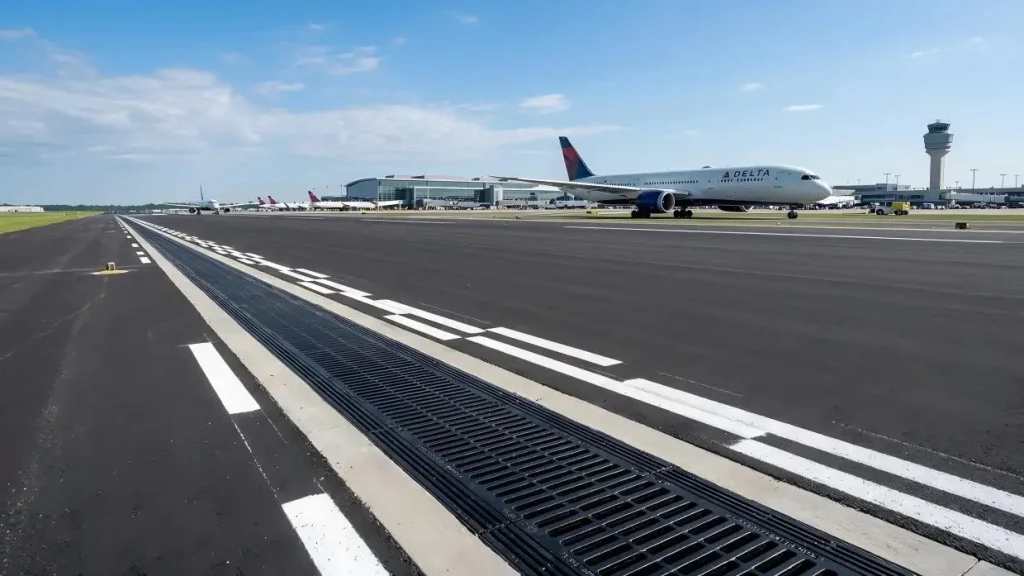
The airside is where all the aircraft operations take place (i.e., runways, taxiways, aprons, hangars, etc.). The airside presents a number of surface and pavement challenges, including:
•Point loads from aircraft that are greater than those of the most loaded road surface.
•Lateral loads from aircraft operations (i.e., landing, turning, braking) that can damage both surface and associated drainage systems.
•Routine contact with aviation fuels and deicing fluids which can damage conventional surface and drainage systems.
•Continuous operations and requirements for maintenance and repairs that are frequently unavailable.
Landside Areas
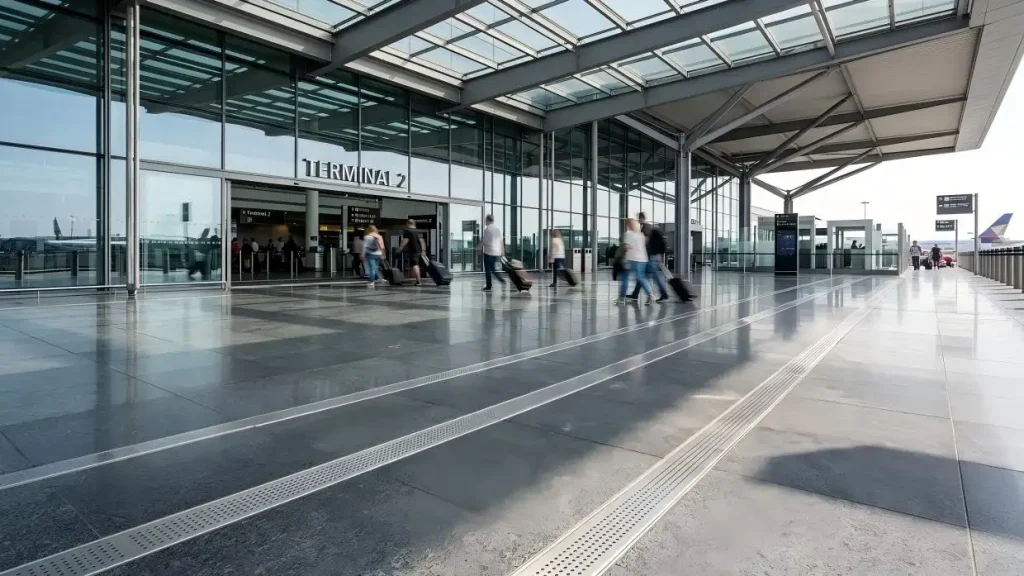
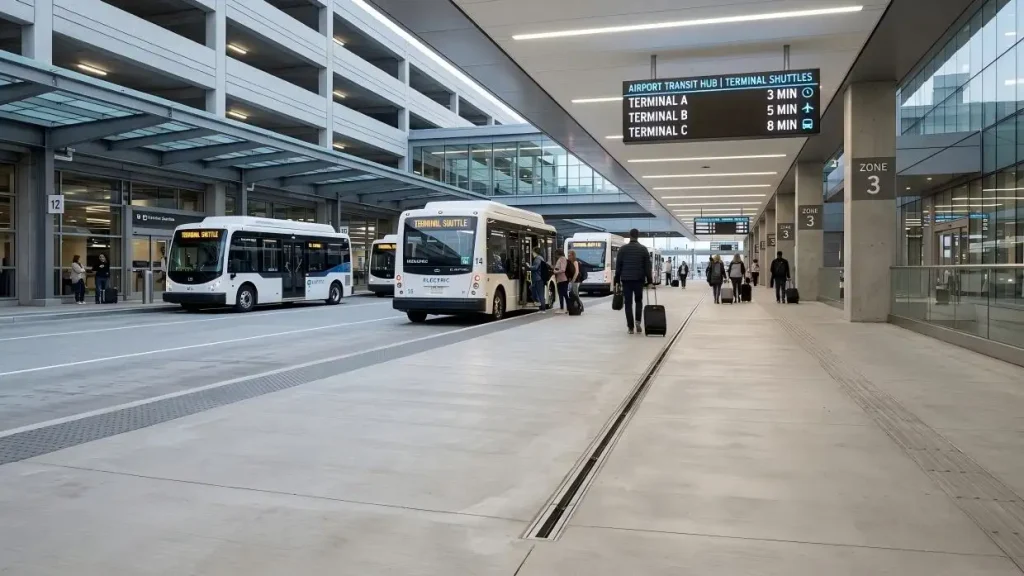
The landside is the public area of the airport and contains the terminals and other support and commercial facilities. The following are some issues presented by landslides:
•The design of drainage systems may be affected by the safe transport of personnel and support trolleys.
•A modern terminal and its design elements include the concealment of drainage systems.
•There is more demand for the treatment of rainwater and for drainage systems with quicker and more efficient drainage.
Load Classification: The F900 Standard for Airport Drainage Systems
European Standard EN 1433 assigns six load classes for drainage channels. They vary by application and range from class A15 (pedestrian areas) to class F900 (extreme heavy-duty applications).
Load Class F900 is the highest class of EN 1433 and is intended for use on surfaces that sustain the highest levels of wheel load and the most intense levels of dynamic loading. For this reason, products in this class are especially important in airport environments, as aircraft would taxi, turn, and brake on top of drainage systems.
For airport applications, the use of F900 rated drainage system components is required on all airside systems. This class of product is sufficiently robust to support the passage of heavy aircraft multiple times, and would not cause drainage system failure, nor pose a safety risk to aircraft.
Key Requirements for Airport Drainage Systems
While the drainage systems of airports must possess several characteristics, they must primarily meet a few critical requirements.
1. Hydraulic Capacity
Drainage from rainfall at airports can be a challenge because of the large run-off generated from the large sealed pavements. The drainage system must be designed to:
•Rapidly collect and move large volumes of water
•Maintain flow capacity without surcharging in the most severe storms
•Avoid ponding on runways and taxiways where the water depth may negatively impact aircraft
2. Structural Integrity
The drainage systems for airports must be capable of addressing the unique mechanical challenges:
•High load capacity: Channels and gratings must be able to accommodate aircraft wheels.
•Dynamic load challenge: The systems must address the challenges of both the static load and the moving aircraft.
•Traffic-induced vibration challenge: Continuous traffic must not cause the gratings to loosen.
3. Durability and Material Resistance
The environment from airports creates a challenge for the drainage system:
•Fuel challenge: Spilt fuel must not degrade the materials.
•De-icing fluid challenge: The materials must resist the corrosion from de-icing fluids.
•Long weathering challenge: The systems must fail in both the summer and winter extremes.
4. Watertightness and Environmental Protection
Designing modern airport drainage systems requires consideration of the following environmental issues:
•Groundwater protection: Sealed channel bodies will blocked contaminated runoff from leaching into the soil and groundwater.
•Pollutants: Runoff from air-side areas may contain fuels, oils, and de-icing chemicals which may require treatment prior to discharge.
•Compliance: Systems will need to meet environmental requirements for water quality.
5. Maintainability
•Sediment Removal: The economic viability of the system over its lifecycle will depend on sediment removal.
•Easily accessed systems will allow for the inspection and removal of sediments without disruption to the airport operations.
•Low maintenance operation and systems: Systems will have smooth internal walls to facilitate cleaning and will be designed to reduce sediment buildup.
CMSA's Engineering Approach to Airport Drainage Systems
CMSA has designed systems to meet the specialized requirements of airport environments. The philosophy behind their designs is to provide systems that are strong and durable, yet hydraulically efficient.
1. Polymer Concrete Technology
Polymer Concrete systems are lightweight yet strong:
•Strength to weight ratios of polymer concrete systems are superior to those of traditional systems which makes handling and installation easier.
•Chemical Resistance: Polymer Concrete systems can be chemically burdened by airport fuels and de-icing chemicals.
•Corrosion Resistance: Polymer Concrete systems will be immune to the corrosion issues that plague metal systems.
2. Integrated Cast Iron Edge Rails
For applications that require an F900 load class performance on the airside, CMSA uses cast iron edge rails in their channel designs:
•Load distribution: Edge rails help distribute the concentrated loads of an aircraft wheel over the channel structure, eliminating the risk of localized failure.
•Grating support: Edge rails help provide the support for the ductile iron gratings ensuring that they do not become dislodged during the application of dynamic loads.
•Durability: A cast iron edge and polymer concrete body provide a durable, long standing solution.
3. Ductile Iron Gratings
For an airport drainage system, gratings are one of the most important systems:
•Wheel load capacity: Ductile iron gratings can support highly concentrated wheel loads.
•Resistance to deformation: Ductile iron can absorb dynamic and impact loading without fracturing.
•Fixings: Vibration does not loosen gratings that are fixed with the PROFIX® quick-lock system or bolted systems.
4. Hydraulic Performance
The ability to remove water quickly from drainage channels is a function of their design and the materials used to form the surface:
•Polished surfaces: Channels made with polymer concrete have smooth internal surfaces, which can increase water velocity and reduce the potential for silt to settle.
•Rapid runoff: Channel designs that have surfaces to promote a swift movement of water reduce the possibility of ponding on adjacent surfaces.
•Hydraulic profiles: Fluctuations in the flow rate of water are minimal, due to the design of the section of channel.
5. Comprehensive Support Services
CMSA's airport drainage project support services encompass the following:
•Drainage calculations: We use advanced software to prepare drainage calculations and provide hydraulic capacity verification.
•Product selection: We select channels and gratings based on the project load and flow.
•Solutions Design: We combine product diagrams with drainage layout solutions.
•BIM Integration: All products and extensive BIM technical support will be provided.
•Training: We offer training, site supervision, and assistance with acceptance testing.
Consequences of Poor Airport Drainage
The following are examples of inadequate drainage design for an airport:
•Damage to materials: Inadequate identification of the load class can result in the deformation of channels and gratings, and damage to the pavement.
•Safety concerns: Foreign object debris (FOD) can occur, posing a safety risk.
•Disruption of airport operations: Maintenance and repair work will halt normal airport operations.
•Damage to the environment: Polluted drainage will have a negative impact on both groundwater and surface water.
•Greater hydroplaning: Poor drainage can cause water to remain on the runway.
Concluding Remarks
CMSA does not view airport drainage systems as utilities. They are designed to ensure the safe movement of aircraft in all weather, therefore, safety is our prime concern. CMSA has the capability and the commitment to ensure that the aircraft, the people who operate the aircraft, and the people who are carried by the aircraft, will not be subjected to the dangers of hydroplaning or the impact of climate change. Robust drainage is a safety concern, especially with climate change and the predicted increase of sustained heavy rainfall.
FAQs
Q: What are the safety concerns of drainage for runways?
A: Without drainage, water would pool and increase the risk of hydroplaning and would affect the friction of the tires during landing and takeoff.
Q: What is the load class for drainage on the airside?
A: The class is F900 for EN 1433, the load class for the highest aircraft wheel load and the highest associated dynamic effects.
Q: What are some of the materials used to make drainage channels at airports?
A: A combination of polymer concrete and cast iron edge rails are strong, lightweight, and resistant to chemicals.
Q: What effect does drainage have on the braking performance of an aircraft?
A: When drainage is effective the pavement is kept dry and braking performance and control is consistent.
Q: What is the difference between airside drainage and landside drainage?
A: F900-rated, chemical-resistant systems are required for airside drainage. Landside drainage is less about the load class, and more about drainage for pedestrians and aesthetics.


