
Shanghai Disneyland Episode: Water Wave Grating Design for Landscape Drainage
Shanghai Disney Resort opened on June 16, 2016, in Pudong New Area. Developed on an approximately 963-acre, or 390-hectare, site, the destination includes Shanghai Disneyland, Disneytown, Wishing Star Park and two operating resort hotels. Shanghai Disneyland now has eight themed lands: Mickey Avenue, Gardens of Imagination, Fantasyland, Treasure Cove, Adventure Isle, Tomorrowland, Disney·Pixar Toy Story Land and Zootopia.
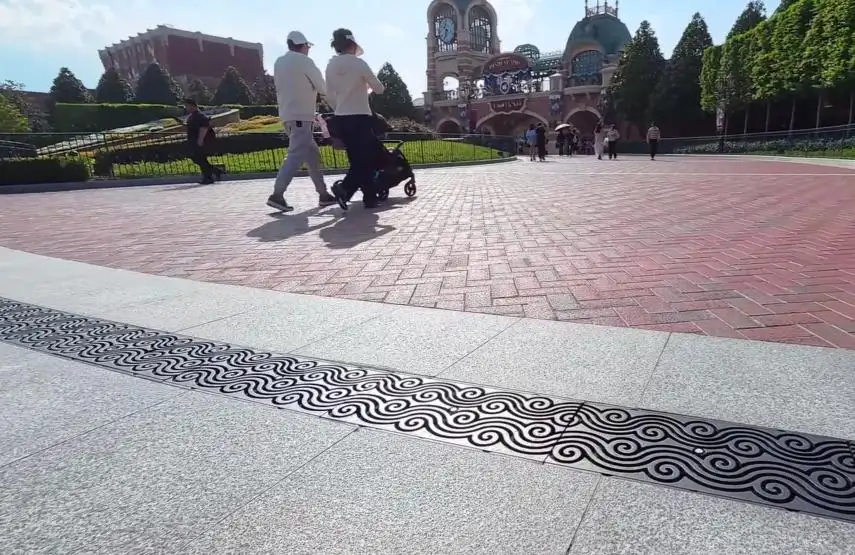
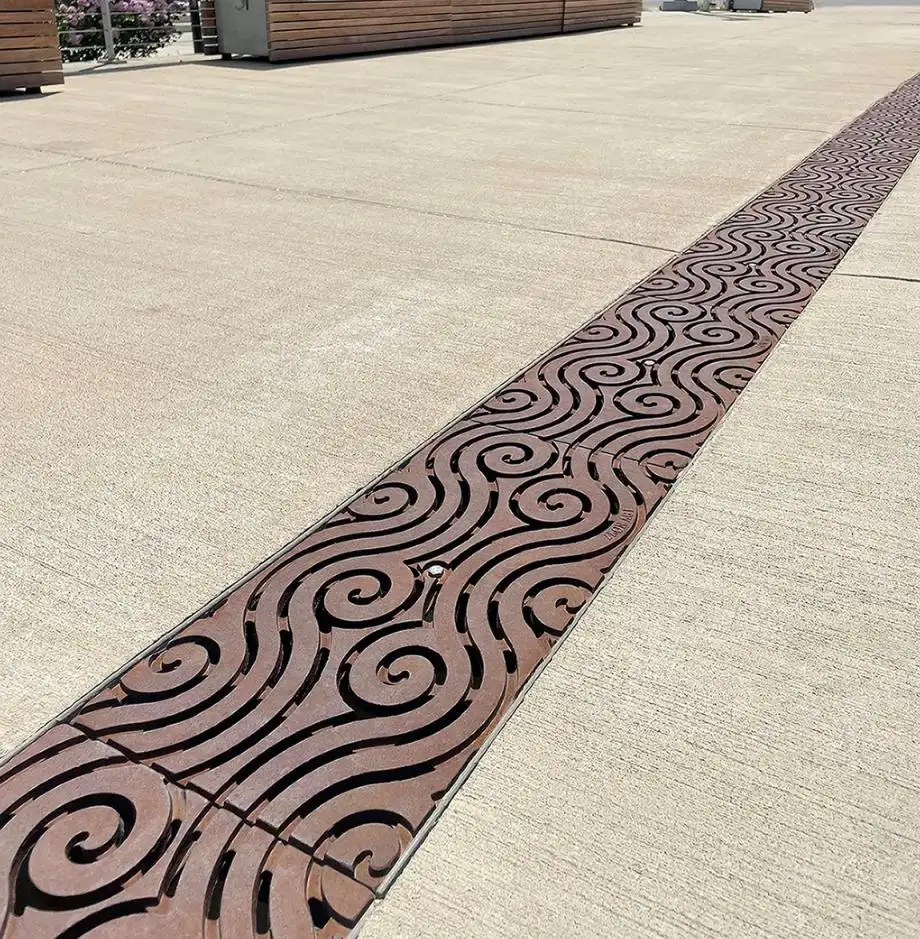
A Water Wave Grating Design can transform a channel cover into an architectural element coordinated with paving, waterways, plazas and themed pedestrian routes. The following discussion uses Shanghai Disneyland as a high-traffic public-environment reference.
A High-Traffic Resort Environment
By June 2026, when Shanghai Disney Resort celebrated its 10th anniversary, the resort had welcomed more than 100 million guest visits since opening. Its 100 millionth guest visit was recorded in October 2025, just over nine years after the resort began operations. More than 90% of surveyed guests rated their Shanghai Disneyland experience as good or excellent, reflecting sustained visitor demand and the operational pressure placed on drainage systems, pedestrian infrastructure and other heavily used public-space facilities.
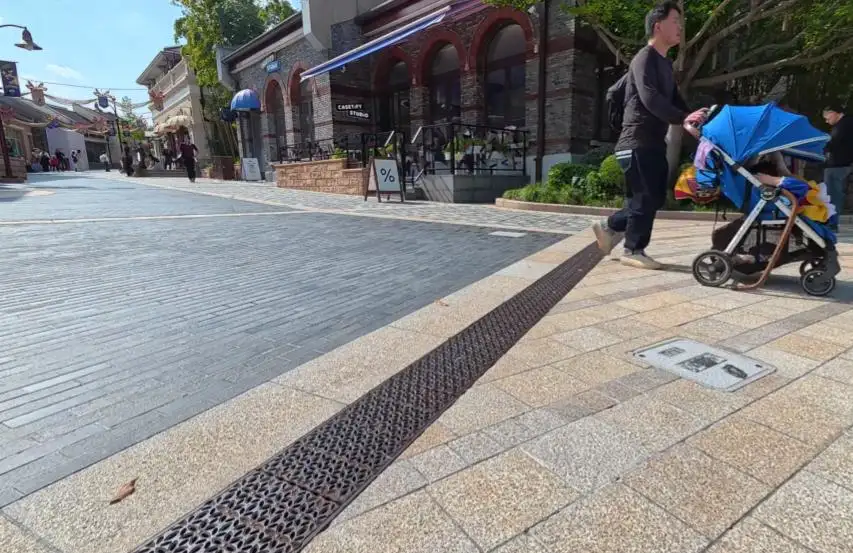
A drainage grating in this environment may be crossed by:
•Adults and children
•Wheelchairs and baby strollers
•Cleaning machines
•Food-service carts
•Maintenance and event equipment
The grating must function as a stormwater inlet, stable walking surface and visually integrated landscape feature.
Why Water Wave Grating Design Fits Shanghai Disneyland
Shanghai Disneyland combines detailed paving, landscaped circulation areas, water-related attractions and story-driven environments. Treasure Cove, Adventure Isle, Wishing Star Lake and Zootopia provide natural contexts for patterns inspired by waves, rivers, ripples and flowing water.
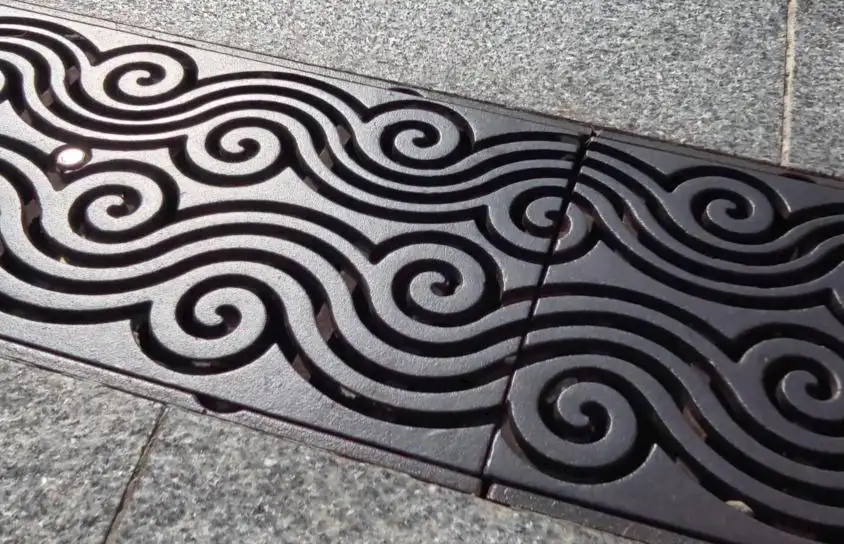
Curved openings can suggest moving water, lagoon edges, natural contours or stylized streams. However, decorative geometry cannot be separated from hydraulic and structural requirements. Every curve influences open area, rib strength, debris retention, cleaning access and wheel safety.
Shanghai Rainfall and Drainage Demand
According to the Shanghai Water Authority, average precipitation during Shanghai’s 2025 flood season reached 762.7 mm, approximately 20% above the long-term average. July alone recorded 270.6 mm of rainfall—twice the normal monthly level—while the city experienced 11 localized extreme-rainfall events and 19 rainstorms during the flood season.
Records of annual rainfall will not be completed until after July 30, 2026. Per the local forecasts, rainfall during the month of August 2026 will be near the seasonal average, with the exception of possibly heavy rainfall due to typhoons.
Annual rainfall provides climate context, but drainage sizing requires project-specific storm intensity. A Water Wave Grating Design should consider:
•Design rainfall intensity and return period
•Catchment area and runoff coefficient
•Surface gradient and low points
•Effective grating open area
•Channel and outlet capacity
•Debris blockage allowance
A simplified rational-method calculation is:
Q = C × i × A ÷ 3,600
Where Q is flow in L/s, C is runoff coefficient, i is rainfall intensity in mm/h and A is catchment area in m².
| Parameter | Illustrative Value |
| Catchment area | 200 m² |
| Rainfall intensity | 150 mm/h |
| Runoff coefficient | 0.90 |
| Calculated flow | 7.5 L/s |
The inlet, channel and outlet must each exceed the required flow, with additional allowance for leaves, packaging and sediment.
Balancing Pattern Detail and Open Area
A denser wave pattern can improve visual continuity but reduce net open area. Larger openings may increase water intake, yet create risks for small wheels, walking aids and footwear.
The key variables include slot width, rib thickness, wave spacing, support span, open-area ratio, and blockage factor. Debris may be trapped by tight curves and narrow ribs may impair structural capacity. Final geometry should accommodate the relevant formal Chinese standards on accessibility, local laws and regulations, and specific requirements of the particular project.
Flush Installation, Materials and Loading
A Water Wave Grating Design should remain flush with stone, concrete or themed paving. Edges require deburring, removable modules must not rock or rattle, and wet surfaces need suitable slip resistance.
Typical material and finish options include:
•304 stainless steel: general outdoor pedestrian zones
•316 stainless steel: frequently wet or more aggressive environments
•Brushed or bead-blasted finish: controlled glare and consistent appearance
•Anti-slip texturing: entrances and water-adjacent areas
Structural verification should cover pedestrians, cleaning machines, supply carts, event equipment and any service vehicles using the route.
How CMSA Grating Design Supports Shanghai Disneyland-Type Requirements
Shanghai Disneyland operates in a high-rainfall coastal environment and receives millions of visitors annually. In such a setting, drainage gratings must manage concentrated stormwater while supporting pedestrian safety, maintenance access and long-term outdoor use.
As the sole distributor in South East Asia of MEA, CMSA provides the MEA® 11A295 ductile iron grating as a durable drainage cover for demanding public, transport and industrial environments. CMSA's unique combination of features allows it to meet the demands of projects that require long-lasting performance.
| Specification | Project Advantage |
| Material | High-strength ductile iron |
| Width | 122 mm to integrate channels with precision |
| Load class | To F900 for very high traffic requirements |
| Compliance | EN 1433 |
| Compatible systems | EN1000, U1000, Z1000 and LZ1000/80 |
| Locking | With or without locking mechanism |
| Project Requirement | CMSA Design Response |
| Heavy seasonal rainfall | Different slot options allow for customization of intake and debris control |
| High visitor traffic | Heavy duty ductile iron provides a strong and durable surface for pedestrians and service traffic |
| Maintenance vehicles | Compliance with EN 1433 and an F900 load class permits heavy duty service areas |
| Humid coastal exposure | Anti-rust coatings reduce corrosion and surface deterioration |
| Operational safety | Optional locking mechanism restricts movement, vibrations and unauthorized removal |
| Layout coordination | Compatibility with EN1000, U1000, Z1000 and LZ1000/80 systems provides drainage layout flexibility |
In Shanghai Disneyland-type settings, CMSA can adjust grating selection according to the design rainfall, channel capacity, paving surfaces, anticipated wheel loads and service routes. This ability allows CMSA to maintain a secure, serviceable and structurally sound drainage system that integrates into the themed landscape.
Pattern Integration and Maintenance
Wave direction should align with paving joints, visitor movement, lighting and landscape geometry. Curved modules, hidden fixings and pattern continuity should be resolved before fabrication.
Each module should be independently removable and easy to reinstall. Inspection sections, sediment baskets and accessible outlets can reduce cleaning time while preserving the themed appearance.
Final Words
Shanghai Disneyland shows why visible infrastructure in a major themed destination must combine hydraulic capacity, pedestrian safety, structural loading, materials, pattern continuity and maintenance planning.
With high annual attendance and concentrated seasonal rainfall, Water Wave Grating Design must be developed as an engineered drainage component—not simply as decoration.
CMSA supports architects, landscape designers and drainage consultants with pattern development, open-area review, module planning, material selection and installation coordination. Project teams can submit rainfall intensity, catchment area, channel dimensions, paving build-up, expected wheel loads and preferred wave geometry for a project-specific review.
FAQs
Q1. What are the specifications of the CMSA MEA® 11A295 grating?
The MEA® 11A295 grating has the following specifications:
•Ductile Iron Grating
•Dimensions: 122 mm Width
•Compliant with: EN 1433
•Loading class: Up to F900
•Locking mechanism: Standard and/or optional
•Compatible with: EN1000, U1000, Z1000 and LZ1000/80
With its anti-rust coating, numerous slot variations, and high load capacity, it can be used in demanding public/service areas.
Q2. What drainage products does CMSA supply?
CMSA offers an extensive range of drainage and water-management products, including:
•Linear drainage channels – polymer concrete
•Gratings – ductile iron and stainless steel
•Architectural drainage – TopSlot
•Stainless steel drainage – hygienic
•Drainage facilities for parking, highways and rail
•Stormwater retention and filtration systems
These products cover the drainage and water management requirements of urban, commercial, and industrial infrastructure.
Q3. Can CMSA provide customized Water Wave Grating Design?
CMSA can provide customized Water Wave Grating Design. A specialized drainage solution can be provided after considering the design and engineering aspects of pattern geometry and slot width; open area; choice of material; loading class; channel compatibilities; and installation requirements. Decorative patterns should be assessed together with hydraulic capacity, pedestrian safety, structural strength, and cleaning access.
Q4. Does CMSA provide hydraulic calculations?
Yes. CMSA can offer hydraulic calculations and reports and can prepare drainage layouts and product drawings with the recommendation of required systems.
To conduct the required hydraulic calculations, the project team should provide the following: rain intensity, catchment area, surface slope, runoff coefficient, length of drainage channel, outlet location, and blockage allowance.
Q5. Can CMSA assist with drainage for landscape and theme park designs?
Absolutely. The drainage systems provided by CMSA and MEA can be utilized for plazas, walkways, landscaped areas, transit facilities, and other large, high-density public areas.
With regard to theme parks, the choice of systems needs to take into account the flow of park guests, strollers, wheelchairs, cleaning equipment, decorative paving and the varying stormwater loading for different seasons.


