
Future Trends of Polymer Concrete Drainage System for Civil Projects in Smart Cities

Smart Cities Use Deeper Drainage Systems Than Traditional Water Removal Systems
Smart cities depend on sophisticated urban drainage systems. More surfaces that do not allow water to penetrate, more intense rainfalls, and greater demands for urban resilience mean drainage systems must be sophisticated beyond simply getting rid of stormwater. Today's systems must provide consistent hydraulic performance, minimize maintenance, and integrate with innovative landscape design and infrastructure systems.
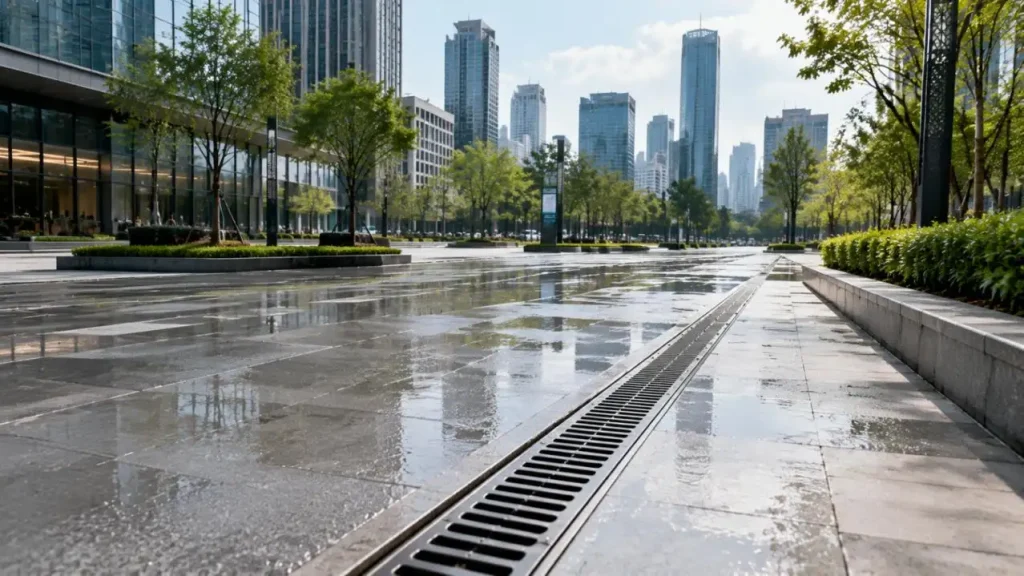
For many years, concrete drainage systems built with traditional channel designs were employed in roads and a multitude of civil construction systems. In the future, however, the use of concrete drainage systems will likely become less and less as our urban designs become more and more innovative. The Polymer Concrete Drainage Systems for Civil Projects are based on polymer resin binders and aggregates and have the potential to fulfill the need for more sophisticated urban surfaces and elaborate drainage systems.
Smart city development requires innovative drainage systems that offer multiple benefits such as protecting cities from flooding, efficient management of water resources, and intelligent systems for the planning and scheduling of maintenance activities.
Material Engineering: Polymer Concrete and Improved Drainage Systems
The innovative Polymer Concrete Drainage Systems brings construction binders to the next level. Unlike traditional cement concrete, polymer concrete is manufactured using polymer binders to create a dense matrix when combined with aggregates.
This structure offers several improvements for many engineering features.
Lower Water Absorption and Better Environmental Resistance
Drainage channels deteriorate due to many reasons, including water penetration. Water that enters a channel after it has been laid, causes:
•Freeze-thaw damage
•Microcrack development
•Cracks that expand and increase channel degradation
•Long-term loss of structural strength
Polymer concrete has better performance than conventional cement concrete with a more stable structure for applications that keep water in contact with concrete for extended periods of time and/or continual changes in weather.
For civil constructions expected to have a service life of 20 to 50 years, reduced water absorption lowers the expected maintenance burden during the service life.
High Strength-to-Weight Performance for Urban Infrastructure
Cities have to build drainage infrastructure to cope with different loads, ranging from pedestrians to heavy goods vehicles.
Polymer Concrete Drainage Systems for Civil Projects are characterized by the interaction of the following factors:
| Engineering Factor | Influence on Performance |
| Material compressive strength | Resistance to external loads |
| Channel geometry | Stress distribution |
| Surrounding concrete support | Prevention of displacement and settlement |
| Grating structure | Distribution of surface loads |
As opposed to selecting systems with the highest load rating, engineers shall consider the actual demands of the application in line with EN 1433.
For example:
| Pedestrian areas | Appearances, smooth drainage and ease of maintenance |
| Parking areas | Resistance to vehicle loading |
| Urban roads | Greater mechanical stability |
| Logistics or industrial zones | High Performance |
Hydraulic Efficiency: Drainage Capacity Depends on More Than Channel Size
There is a common misconception that bigger drains perform better. In reality, the efficiency of a drain is a function of many factors.
These include:
•Channel cross section design
•Internal surface alignment
•Velocity of the flowing water
•Arrangement of drains
•Slope of installation
A smoother polymer concrete channel surface helps to reduce the resistance to water flow, thereby enhance drainage efficiency and reduce the buildup of sediments.
This is important for smart cities where the limiting of press for maintenance may negatively affect the continuity of service.
Future Trend 1: The Intensity of Ductile Iron Grating Design and Strength
Ductile iron gratings are specifically engineered to adapt seamlessly with polymer concrete drainage channels in civil infrastructure projects. This integration provides a sustainable solution that combines the high tensile strength of ductile iron with the lightweight yet robust channel body of polymer concrete.
Certified to withstand F900 loading class, these gratings are designed for extreme point loads such as aircraft wheels on airport runways, making them ideal for high‑stress civil applications. The optimized water flow rates through smooth channel walls enhance drainage velocity, prevent sediment buildup, and ensure consistent stormwater management. This makes ductile iron gratings not only suitable for heavy transport zones but also perfect for demanding landscape projects where both strength and aesthetics are critical.
Future Polymer Concrete Drainage Systems for Civil Projects will focus more on low maintenance through optimized channel structures.
These systems have other advantages such as:
- F900 Load Resistance – Withstands extreme point loads, suitable for airport runways and heavy transport zones.
- Hydraulic Efficiency – Smooth internal channel walls enhance water flow rates and reduce sediment buildup.
- Sustainable Design – Combines ductile iron durability with polymer concrete’s eco‑friendly, lightweight structure.
- Versatile Applications – Perfect for civil projects, urban landscapes, and large‑scale infrastructure requiring both strength and aesthetics.
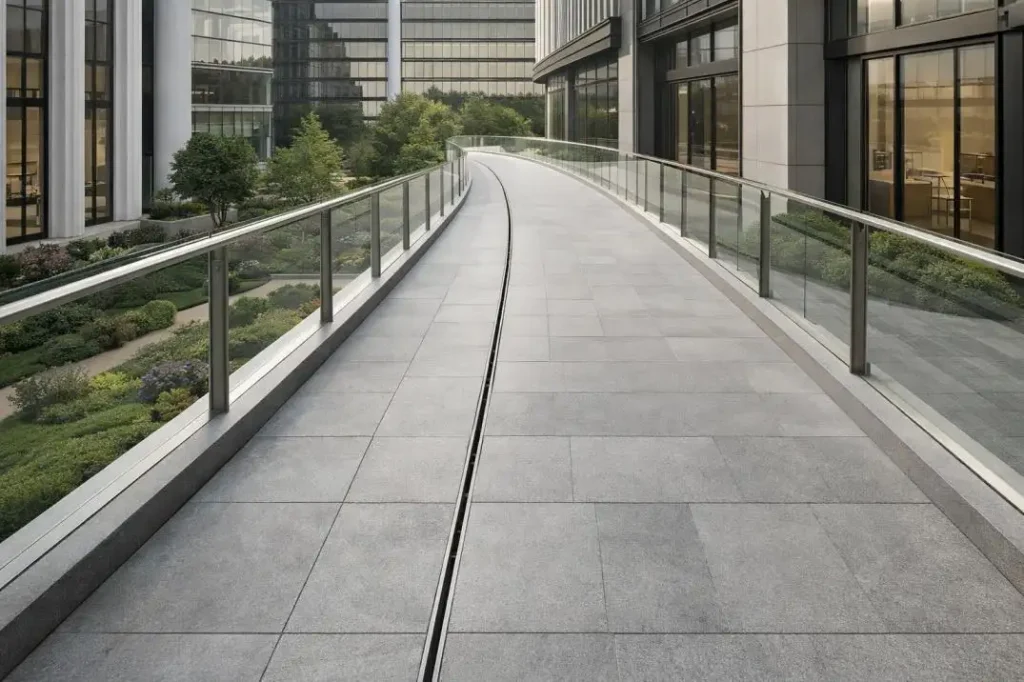
Future Trend 2: Architectural Integration Through Slot Drainage Technology
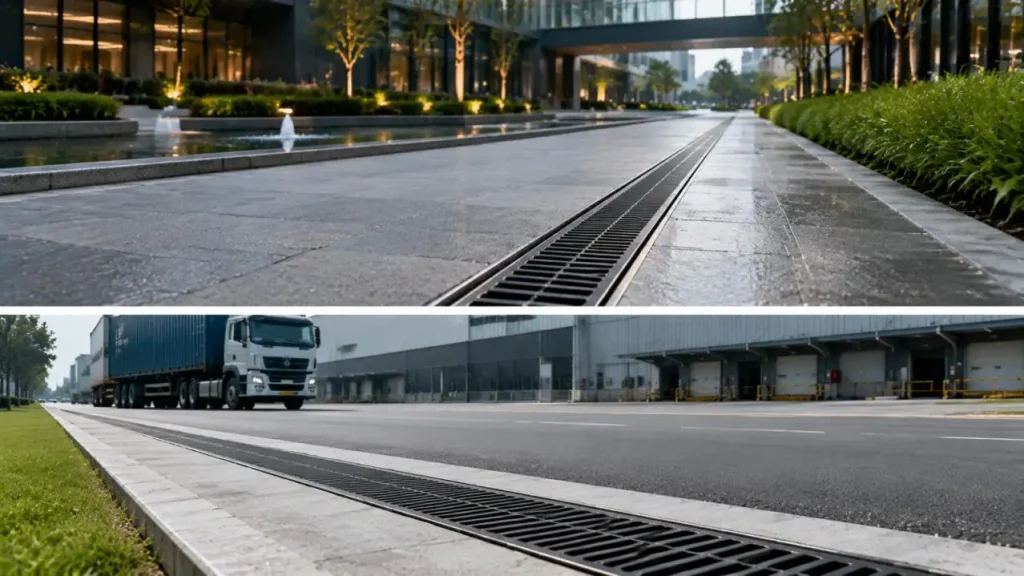
More and more, modern urban projects require drainage systems that are efficient and functional while not impractical and unsightly.
Traditional grated drains interrupt continuity of the surface especially in:
•Luxury Commercial Developments
•Public Plazas
•Landscape Projects
•Building Entrance Areas
A slot drainage system provides efficient water collection while having a narrow surface opening and slot.
CMSA offers fully customizable slot drainage systems with features such as:
•Channel slot widths from 4" to 12"
•Multiple slot configurations
•Slots can be positioned infinitely
Covers are offered in multiple thicknesses to accommodate project requirements
This system allows designers to create pavement systems so drainage infrastructure and landscape systems are not in conflict with one another.
Future Trend 3: Higher Load Performance for Multi-Functional Urban Spaces
In the context of smart city design, public spaces must be able to accommodate many functions. A plaza designed for pedestrian use may need to shift to other uses.
Flexible load performance is essential for drainage systems.
CMSA drainage systems have load capacity options that reach the D400 classification, meaning these can be used in areas subjected to higher truck loading conditions. These systems can be tested by third parties.
The following factors should be accounted for during the selection process:
| Factor | Explanation |
| Traffic frequency | Defines the required load class. |
| Vehicle type | Impacts the loading type. |
| Pavement structure | Factor stabilizes channels. |
| Maintenance access | Determines the long-term usability. |
Future Trend 4: Smart Water Management Systems
Data management will drive urban drainage in the future.
Smart drainage networks may integrate:
•Rainfall monitoring
•Water level sensors
•Flood prediction systems
•Digital maintenance systems
When integrated with BIM, smart drainage networks can be analyzed before and throughout their service lives.
For the manufacturers of smart drainage systems, providing engineering data and digital documentation may be as important as engineering the physical products.
Engineering Support: From Drain Design to Project Completion
The Polymer Concrete Drainage System is more than high-performance material. Performance in the field depends on both hydraulic design and accurate system INSTALLATION.
CMSA provides various other services during the project design and construction phases, which include:
•Drainage design capacity
•Drawing and placement of drains
•BIM support
•Guidance for installation and construction
This service helps mitigate some of the more challenging issues related to drainage channel design, drainage capacity, and drainage system design.
Smart Urban Drainage Infrastructure of the Future
In the creation of smart cities, drainage infrastructure will need to have a long service life, high hydraulic efficiency, aesthetic compatibility, and low maintenance.
A Polymer Concrete Drainage System for Civil Projects meets these requirements and provides urban drainage systems that support the needs of future urban development.
CMSA offers highly customized drainage systems combined with high-performance materials and civil engineering support to create innovative urban drainage solutions with future-generational urban drainage systems.
FAQs
Q1. What makes CMSA's Polymer Concrete Drainage System applicable to civil projects?
CMSA's Polymer Concrete Drainage System is applicable to civil projects for use in modern infrastructure where high durability, the management of water efficiently, and reliability of load performance are integral. CMSA's system combines polymer concrete and optimized channel structures to improve drainage efficiency and reduce long-term maintenance requirements.
Q2. What are some civil and urban infrastructure project applications for CMSA's drainage systems?
CMSA drainage systems can be integrated into urban civil and infrastructure projects such as:
•City squares
•Pedestrian areas
•Landscape zones
•Commercial developments
•Building developments
•Parking lots
•Schools
•Hospitals
The systems can be designed to suit different demands of the environment and loading conditions.
Q3. How does CMSA improve drainage efficiency and performance of self-cleaning?
CMSA drainage systems implement optimized channel structures and smooth internal surfaces to improve water flow and reduce sediment build-up. In urban environments, this ensures the performance of drainage systems and reduces the intervals of required cleanings.
Q4. What load classes are offered for CMSA's drainage systems?
CMSA drainage systems can be engineered to suit drainage and loading conditions. Some systems have been tested by third parties and can be rated for D400 loads which makes them appropriate for use in highways and other areas of urban infrastructure.
Q5. Can CMSA design drainage systems to facilitate different architectural designs?
CMSA can provide different drainage configurations suited to project requirements to include:
•Different slot designs
•Various channel widths
•Adjustable installation heights
•Custom drainage arrangements
This provides engineers and architects with greater innovations and flexibility in designing infrastructure for modern urban landscapes.


