
EN 1433 Polymer Concrete Drainage Channel Load Classification: Selection and Design Guide

Drainage channels installed in roads, logistics centers, industrial facilities, airports, ports, and commercial areas must perform two functions: remove surface water efficiently and withstand repeated mechanical loading.

The EN 1433 Polymer Concrete Drainage Channel Load Classification helps engineers select a drainage system for the expected operating environment. However, classification is not simply a strength value. System performance depends on:
•Channel-body strength
•Grating and frame load resistance
•Concrete surround and foundation design
•Traffic frequency and wheel loads
•Braking, turning, and impact forces
•Chemical and environmental exposure
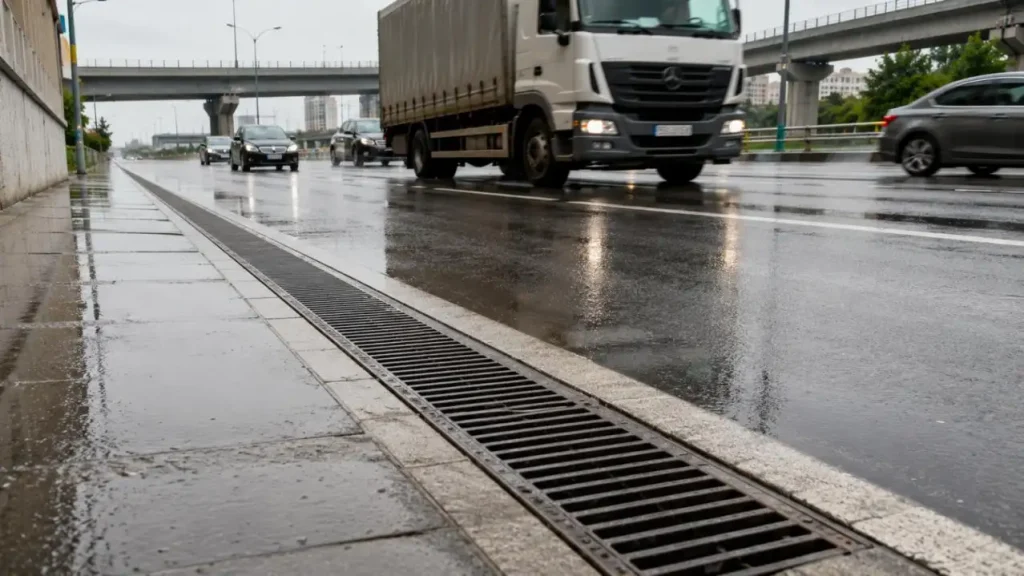
A channel installed near a highway or loading yard experiences vertical pressure as well as dynamic forces from vehicle movement. Correct classification is therefore essential for preventing channel cracking, grating movement, settlement, and premature system failure.
Understanding EN 1433 Polymer Concrete Drainage Channel Load Classification
EN 1433 classifies drainage channels according to their tested load resistance. Engineers should select the class that matches the installation location and service conditions—not automatically specify the highest available class.
| Load Class | Test Load | Typical Applications |
| A15 | 15 kN | Pedestrian areas, gardens, and landscaping |
| B125 | 125 kN | Residential driveways and private parking areas |
| C250 | 250 kN | Kerbside channels and commercial parking areas |
| D400 | 400 kN | Public roads, carriageways, and truck traffic zones |
| E600 | 600 kN | Industrial yards and heavy-equipment areas |
| F900 | 900 kN | Airports, ports, and container terminals |
A common engineering mistake is to match the load class directly to total vehicle weight. The EN 1433 Polymer Concrete Drainage Channel Load Classification represents a test force, while actual performance is also influenced by wheel-contact pressure, axle configuration, traffic frequency, impact loads, and installation support.
A D400 channel may be assigned to a public road, but that doesn't mean there won't be other issues with failure due to inadequate concrete encasement or an unstable subgrade.
How Does Polymer Concrete Increase Load Reliability?
Polymer concrete is a denser concrete with a lower-porosity structure, due to it being composed of resin binders and mineral aggregates. Because of this, it is able to withstand more extreme and more aggressive environments than regular cement concrete, and has a better mechanical stability.
High Compressive Strength
Some specifications of polymer concrete have a minimum required compressive strength of 90 MPa in order to design and test against those requirements. This strength would help the channel resist:
•Repeated vehicle loads
•Concentrated wheel pressure
•Heavy-traffic impact
•Grating and frame reaction forces
Low Water Absorption
Because of its dense structure, polymer concrete doesn't absorb much moisture, which means it can be used in environments that have a lot of moisture and a high chance of freezing, as well as minimize maintenance.
Chemical and Abrasion Resistance
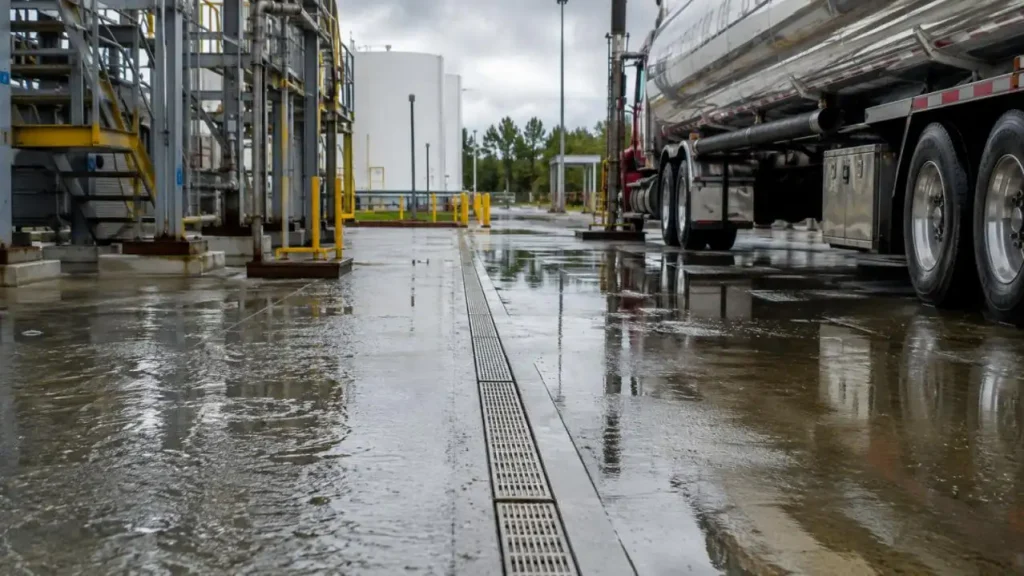
Drainage channels can be exposed to a lot of things that can be abrasive and aggressive such as fuels, oils, wash waters, road salts, and other debris. In these situations, polymer concrete can help keep the integrity of the channel.
Selecting the Appropriate EN 1433 Load Class
The following factors must be considered on a case-by-case basis to determine the appropriate EN 1433 Load Classification for Polymer Concrete Drainage Channels:
•Maximum wheel loads
•Type of vehicle and traffic
•Wheel/track braking, turning, or impact
•Demand for hydraulic flow
•Design of the foundation and surrounding concrete
•Service life and access for maintenance
•Chemical exposure and climate
| Project Environment | Loading Characteristics | Typical Class Consideration |
| Residential area | Occasional vehicle access | A15-B125 |
| Shopping center parking | Repeated passenger vehicles | B125-C250 |
| Public road/Highway | Continuous vehicle movement | D400 |
| Distribution center | Trucks/forklifts/loading activity | D400-E600 |
| Port/Airport | Wheel loads/operational extreme | E600-F900 |
The following ranges are preliminary guidelines. The final decision should be made based on the exact location of installation, project requirements, legally applicable rules, and structural design calculations.
For heavy-duty projects, both load resistance and hydraulic capacity must be ensured. It is of no use to design a drainage channel with a robust construction to resist all the loads if the clear width of the channel, the arrangement of the outlets, and the flow capacity of the channel cannot discharge the design volume of the storm water.
Why Installation Directly Affects Load Performance
The rated performance of an EN 1433 Polymer Concrete Drainage Channel Load Classification applies to the complete installed system—not only the channel body.
Concrete Surround
Concrete encasements distribute external loads to the adjacent pavement structure. If the concrete is too thin or has a weak material selection, stress concentrations can occur and lead to failure in the form of cracking.
Grating and Frame Integration
The load rating for the grating, frame, and locking system must be identical. In situations of heavy traffic, grating must be secured to prevent movement and the resulting noise and displacement.
Foundation Stability
Settlement and poor bedding can result in bending moments that are in excess of what is intended in the design. A stable foundation ensures that the load is transmitted uniformly along the channel.
CMSA EN 1433 Polymer Concrete Drainage Solutions
CMSA offers polymer concrete drainage systems for heavy-duty and urban applications. Our drainage systems cover EN 1433 load classes from A15 to F900 for different types of traffic including pedestrians, industrial, ports and airports.
The systems have the following characteristics:
•Load classes from A15 to F900
•Clear widths from 100 to 500 mm
•Bodies of polymer concrete that have low absorption and are high in strength
•Resistance to chemicals, abrasion, and moisture
•Designs of channels that are no-fall, stepped-fall, and linear-fall
•Modular systems that are configurable to fulfill different functions
•Custom systems for building drainage, airports, and highways
CMSA assesses the EN 1433 Polymer Concrete Drainage Channel Load Classification in conjunction with the hydraulic capacity, grating selection, and other aspects of the system and project to determine the channel installation requirements.
Conclusion
Selecting an EN 1433 Polymer Concrete Drainage Channel Load Classification involves more than selecting a class associated with a vehicle type. There are numerous factors such as the load conditions, stability of the foundation, channel material, and the design of the surround concrete that affect the system as a whole.
CMSA uses classified engineering and installed design to help project teams create more secure, long-lasting, and lower-maintenance drainage systems for infrastructure.
FAQs
Q1. What are the Load Class Ratings of Polymer Concrete Drainage Systems?
Polymer Concrete Drainage Systems have Load Class Ratings that define maximum tested loads of drainage channels based on construction standards such as EN 1433. There are a variety of Load Classifications with CMSA Drainage Systems designed to meet needs from pedestrian areas up to coverage of heavy-duty infrastructure.
Q2. Which Load Class is appropriate for highway and truck traffic areas?
For highway and truck traffic areas, drainage systems typically need to have load classifications in the D400 range, or higher. For areas requiring mechanical strength combined with long-term durability, CMSA has designed Polymer Concrete Drainage Systems.
Q3. Why does CMSA use polymer concrete for its drainage systems?
Polymer concrete gives high mechanical strength, low water absorption, good resistance to chemicals, and good resistance to wear. These characteristics ensure that the drainage systems maintain performance in the most demanding conditions of industry, transport, and urban infrastructure.
Q4. Are CMSA's polymer concrete drainage systems suitable for use in airport applications?
Yes. All airport areas have high loading systems together with constant operational demands, so need high-performance drainage systems. CMSA has high-load drainage systems appropriate for tough applications and strong structural stability and stormwater management systems.
Q5. How does polymer concrete affect the drainage system?
Polymer concrete has a dense, low-porosity structure with improved resistance to freeze-thaw, chemicals, and abrasion. This results in longer service life and less maintenance.


