
Design Considerations When Hotels and Restaurants Rely on Modern Drainage Systems

Why Hotels and Restaurants Rely on Modern Drainage Systems for Better Hygiene
In the commercial hospitality industry, drainage is no longer a consideration for the end of the design process. Drainage systems can affect food safety, workplace safety, ease of cleaning, and the efficiency of day-to-day operations of a business. By comparison, residential drainage systems are impacted by occasional discharges of wastewater. Commercial hospitality systems are challenged by continuous discharges of wastewater, frequent cleaning cycles, high-temperature system disinfection, and/or chemical and grease buildup.
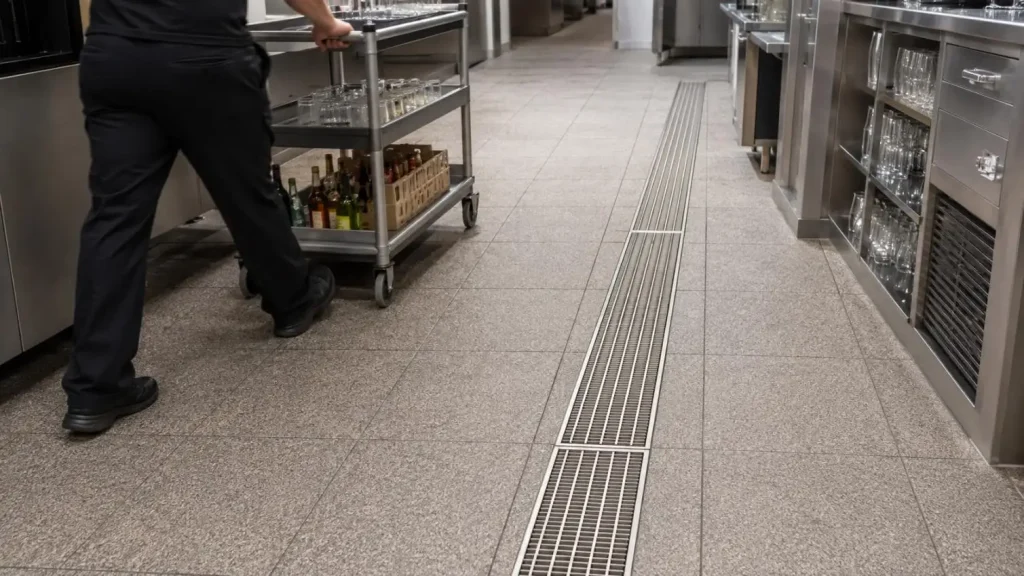
For this reason, hotels and restaurants rely on advanced drainage systems designed with the specific operation of the facility in mind.
A hospitality drainage system must do many things concurrently. It should:
•Remove wastewater during peak periods
•Control standing water in preparation areas
•Ease cleaning and sanitation
•Offer a service life resistant to corrosion and chemicals
•Resist the effects of high usage
For restaurants, where cleaning may occur many times a day, drainage performance affects hygiene management and the overall running of the business.
Hydraulic Design: Matching Drainage Capacity to Real Kitchen Conditions
The most crucial aspect of modern drainage systems is capacity.
In commercial kitchens, drainage loads may be high but short in duration. For instance, dishwashers, cleaning stations, plus a combination of cooking equipment and floor washers, can lead to high drainage loads.
A professional drainage design needs to consider:
| Hydraulic Factor | Engineering Consideration |
| Flow rate (L/s) | Required drainage capacity |
| Channel width and depth | Influences volume of water collected |
| Outlet diameter | Controls velocity of discharged water |
| Floor gradient | Determines the path of wastewater |
| Drainage layout | Prevents localized stagnation of water |
The target is not to install the largest drainage channel possible. Installing oversized systems may inflate costs, while installing undersized channels may create an overflow risk. The correct method is to determine what the peak conditions for wastewater will be and then choose a drainage system that best matches the conditions.
Designs to Reduce Contamination Risks in the Food Preparation Zone
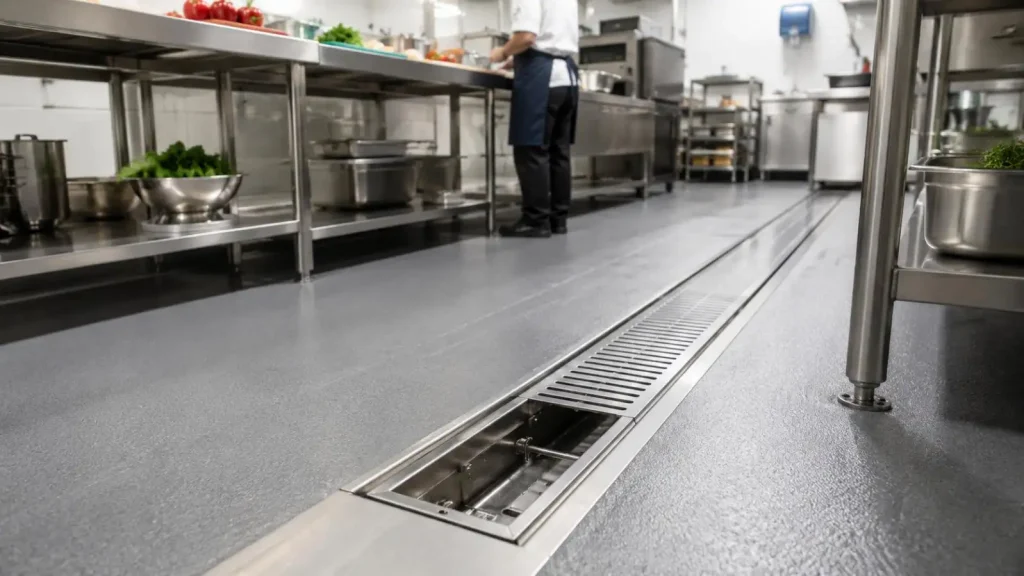
For hotels and restaurants, drainage systems are closely related to sanitation control. Contamination can occur if internal structures of a drainage channel used in the kitchen and food preparation zone retain grease, food particles, or residues of cleaning.
The focus of modern hygienic drainage systems is the minimization of residue accumulation through intelligent design.
The main features of the design include:
•Large internal corner radii to enhance free water flow and ease cleaning
•Smooth stainless steel surface to minimize particle retention
•Sealed construction to prevent contamination of the floor surface
•Removable grates for inspection and maintenance
•Anti slip surface to ensure employee safety
Hygienic designs use smoother surfaces and remove sharp corners to enhance sanitation performance and reduce cleaning difficulty compared to traditional drainage systems.
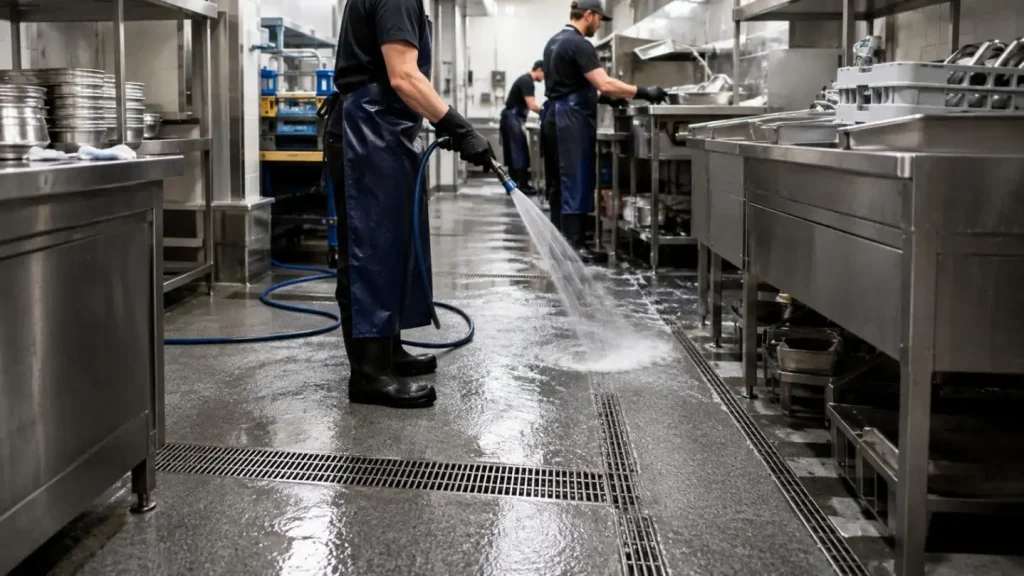
Stainless Steel Washout Systems for Hospitality Industry
The challenge for any commercial kitchen is the environment that wastewater and cleaning chemicals must pass through, in combination with the effects of hot moisture and mechanical abuse.
One of the primary reasons that stainless steel drainage systems are employed is their combination of corrosion and CIP (clean in place) system resistance.
| Performance Requirement | Stainless Steel Advantage |
| Corrosion resistance | 304 stainless steel is adequate for the majority of general commercial conditions |
| Chemical exposure | 316L stainless steel is more appropriate in harsher scenarios |
| Temperature resistance | Suitable for hot water cleaning processes |
| Surface hygiene | Non-porous surface supports easier cleaning |
| Lifecycle performance | Reduces replacement frequency |
CMSA's hygienic stainless steel drainage systems use 304/316L stainless steel, making them strong enough to handle commercial kitchen and hospitality environments.
The material selection is not only about strength; it directly affects cleaning efficiency, maintenance frequency, and long-term operating costs.
Drainage System Selection Based on Different Hospitality Zones
Applying the same solution for all hotel and restaurant projects is a common mistake. Different areas will have different performance requirements.
| Area | Main Challenge | Recommended Design Focus |
| Commercial kitchen | High volume of wastewater with grease, cleaning frequency | High-flow hygienic drainage |
| Food preparation area | Food residue | Smooth internal surfaces and easy maintenance |
| Beverage area | Constantly discharging liquid | Efficient drainage capacity |
| Laundry facilities | Exposure to heat and chemicals | Corrosion resistant |
| Service corridors | Cart traffic and impact loads | Load-rated grating |
A good drainage system is designed to be incorporated into the overall building layout in conjunction with the floor, the cleaning plan, and the maintenance access.
Modular Drainage Systems Improve Installation Flexibility
Hospitality projects have complex kitchen, restaurant, and service area layouts, and therefore require flexible drain systems compared to the traditional.
Modular drain systems offer the following:
•Projects can be built on site in shorter time frames.
•Changes to the system design are easy to implement.
•Old drain components can easily be swapped out for new customized drain components.
•Consistent manufacturing processes.
CMSA offers flexible drainage solutions. These solutions include hygienic drainage channels, drains, box channels, grates, customizable components, etc.
For example, component layouts can be customized based on desired drainage outlet positions and the design of the access grates and drainage channel components.
Drainage Grates: Safety, Hygiene, and Load Performance
Drainage grates play an important role in the daily use of a floor and maintain safe and hygienic operation.
Important factors:
•Capacity to support a load
•Slip resistance
•Cleaning access
•Corrosion rate
•Surface treatment
CMSA stainless steel grates come in various designs and surface treatments which contribute to surface protection and drainage grate hygienic performance.
The correct grate design helps achieve a balance between drainage efficiency, employee safety, and convenience when cleaning.
Installation and Maintenance Factors Affecting Long-Term Performance
The performance of a drainage system depends on a number of factors, including maintenance and the quality of the component installation.
Even with high quality components, performance will not be achieved if proper installation of the drainage system is not completed.
Floor Slope Integration
Drainage efficiency depends on proper floor gradient design. Incorrect slope positioning may leave standing water even when channel capacity is sufficient.
Sealing Performance
Creating a barrier to the passage of moisture protects surrounding structures from degradation and future costly maintenance.
Maintenance Accessibility
A good drainage system should facilitate:
•Removal of grates and covers
•Cleaning
•Inspections
•Replacement of components
CMSA helps engineering teams with drainage calculations, layouts, BIM services, and installation aids to help improve a project from design to completion.
Standards and Verification of Commercial Drainage Systems
When hotel or restaurant owners consider purchasing drainage systems, those systems must meet the appropriate industry standards.
| Standard | Application |
| EN 1253 | Building drainage gullies and indoor drainage components |
| EN 1433 | Drainage channels used in pedestrian and traffic areas |
| EN 16165 | Slip resistance testing methods |
| CE Certification | Product conformity verification |
CMSA's hygienic drainage solutions are designed with compliance in mind to enhance performance in any professional commercial setting.
Designing User Friendly Hospitality CMSA Drainage Systems
With the introduction of sophisticated drainage systems, the hospitality industry has moved past the requirement of simply removing wastewater. Now, complete systems are built to provide hygiene-focused drainage engineering.
The perfect balance of the following components is needed to create a successful drainage system:
•Proper hygienic design
•Proper structural design
•Stainless steel
•Modular design
•Protocol compliance
•Long term maintenance plan
Hygienic stainless steel drainage systems designed specifically for the hospitality industry are the focus of CMSA. Modular drainage systems reduce both time and money for the project team while maintaining the goal of enhancing safety, cleanliness, and sustainability of hotel and restaurant operations.
FAQs
Q1.Why do hotels and restaurants replace conventional floor drains with more advanced drainage systems?
Hotels and restaurants have high volumes of wastewater from cleaning and food preparation and daily operations. The CMSA drainage systems have others that have higher flow capacities, are hygienically designed, and are easy to maintain.
Q2. What materials do CMSA hygienic drainage systems use?
CMSA hygienic drainage products are made from 304 and 316L stainless steels. They have a high degree of resistance to corrosion and heat, and provide a long service life in commercial kitchens, food processing areas and hospitality environments.
Q3. What makes stainless steel good for restaurant kitchen drainage?
Stainless steel has a non-porous surface that means cleaning agents and moisture cannot penetrate the surface easily and help reduce the accumulation of residue on the surface. Compared with other material used for drainage, stainless steel has better resistance to the combination of moisture, chemicals, and high temperatures of wastewater.
Q4. In what way do CMSA drainage systems improve hygiene?
CMSA has designed its drainage systems to incorporate smooth surfaces on the interior and large radius corners, as well as sealed systems. They employ open grating systems to further reduce trapping sites for grease and food particles.
Q5. Are CMSA drainage systems adaptable to different hotel and restaurant configurations?
Yes, CMSA has a variety of systems that include multiple drain arrangements, channel configurations, grating, and accessories to meet different requirements.


