Polymer Concrete Drainage Solutions: Buyer's Guide From Requirements To Ready-To-Build Specs
Polymer concrete drainage solutions are becoming the default choice for projects that need reliable flow, stable geometry, and a long service life under real-world site abuse. At CMSA, we build drainage for civil and industrial users. This buyer's guide explains what to check before you compare models or quotes—using a clear, practical approach to get you from needs assessment to build-ready specs.
1) Start With the "Job Description" of Your Site
Before you choose a channel size, define what your drain must survive every day. Polymer concrete is often selected because it behaves more like a precision-shaped, low-porosity structure than traditional cement concrete. In published material data, polymer concrete can reach compressive strengths around ~58–95 MPa depending on binder system and formulation.
At CMSA, we recommend writing a one-page site profile first:
• Traffic type (pedestrians, cars, forklifts, trucks)
• Surface type (asphalt, pavers, tile, epoxy floor)
• Exposure (freeze–thaw, de-icing salts, washdown chemicals)
• Maintenance reality (who cleans it, how often, with what tools)
This profile makes every subsequent decision faster and prevents buying "overspec" products you do not need.
2) Choose the Correct Load Class (Don't Guess)
Load class is still the most common reason projects require re-specification after bidding. The European standard EN 1433 uses six load classifications from A15 to F900.
A simple way to think about it:
• A15: pedestrian / cycle areas
• B125: light vehicles, car parks
• C250: curbside zones
• D400: roadways, frequent vehicle loads
• E600: heavy industrial traffic
• F900: extreme loads (ports, aircraft areas)
Buyer rule: Select the load class based on the worst realistic condition, not the average. If forklifts cross the channel even twice a day, that matters.
CMSA TopSlot has been tested by national third-party testing institutions, and its bearing grade can reach Class D400. For 2026 buyers, that is a meaningful signal because it shows the system is suitable for heavy-load scenarios when the project demands it. In practical terms, a D400-rated system can help you:
- Reduce the risk of "unexpected load" failures
- Protect the pavement edges around the channel
- Avoid early replacement cycles in high-use public areas
If you are comparing Polymer Concrete Drainage Solutions, ask every supplier to explain the tested load class and where that class is appropriate on your site plan.
3) Size for Flow Using Simple, Practical Logic
Many first-time buyers assume "wider is safer." In real installations, performance depends on how water enters the system, not only channel width.
At CMSA, we size Polymer Concrete Drainage Solutions using three practical questions:
• Where does the water come from? (roof runoff, washdown, slope drainage)
• How does it reach the drain? (surface slope, trench direction, local low points)
• Where does it exit? (outlet location, pipe diameter, downstream restriction)
A useful mindset: If your outlet or downstream pipe is undersized, a bigger channel will not fix the bottleneck. In that case, we adjust the outlet strategy rather than simply upsizing the entire line.
H2: 4) Understand What Polymer Concrete Material Gives You
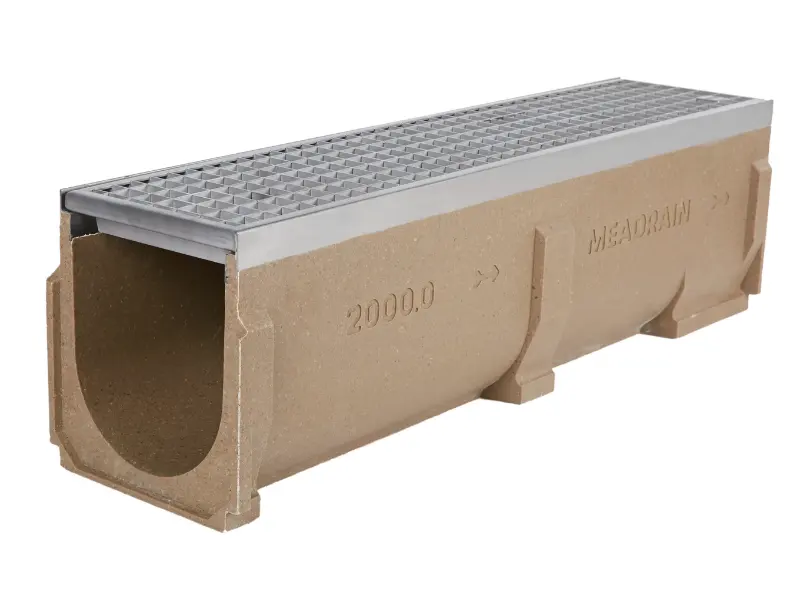
Polymer concrete is not "regular concrete with a coating." It is a composite where polymer binder replaces Portland cement as the primary binder. This delivers high strength, consistent geometry, and reduced porosity.
What this means in practice for your drainage system:
• Fast Strength Gain: Polymer concrete reaches ~70–75% of its strength after just one day, which is highly useful when construction schedules are tight.
5) Pick the Right Grate Strategy and Locking Detail
Most failures we see are not "channel body problems." They come from the top: grates, seating, and locking mechanisms. Focus on three items:
• Grate material match: stainless for hygiene/corrosion zones, ductile iron for high-load traffic, and designs that suit cleaning tools and slip needs.
• Locking method: choose a system that can stay secure under vibration and traffic, yet still allows maintenance access.
• Inlet style: slot, heel-proof, or open grating should match safety requirements and debris type (leaves, packaging, sand, food residue).
6) CMSA TopSlot: Designed for Urban Hard-Pavements
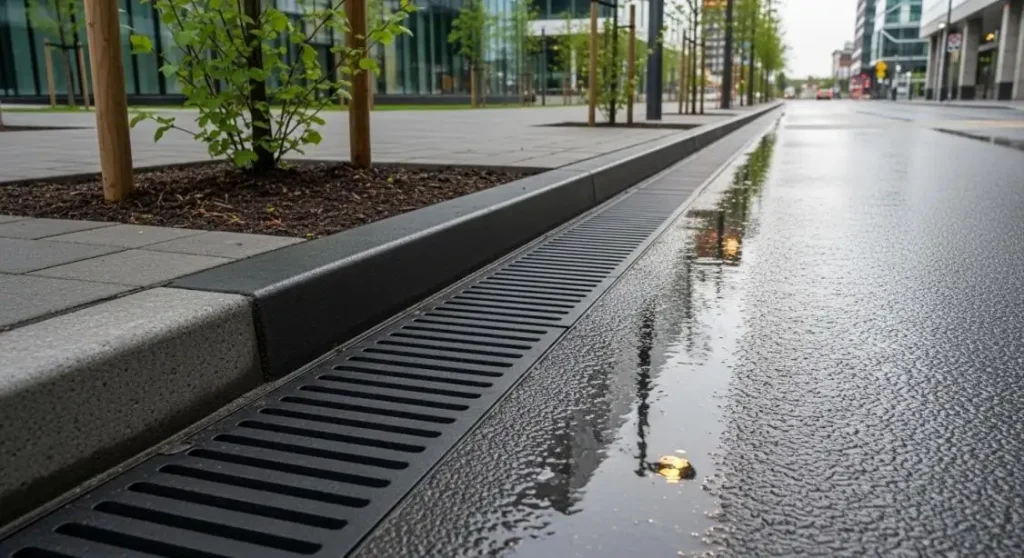
CMSA TopSlot is a TopSlot drainage solution built for efficient urban drainage and a self-cleaning flow path. It is compatible with different hard pavement materials, which makes it easier to integrate into common surface designs used in public spaces. The appearance is simple and clean, so you can keep the visual style of stone, tile, or concrete paving without a "busy" drainage look.
From a buyer's perspective, the practical value is the combination of features:
- Excellent Drainage Capacity that helps reduce ponding after rain or washdown
- Self-Cleaning Design that helps reduce sediment build-up in daily use
- Aesthetic Appearance that protects the intended architectural lines
7) CMSA Technical Support: From Calculation to Installation
A drainage product is only as successful as the design and installation around it. CMSA supports projects not only with Polymer Concrete Drainage Solutions, but with practical engineering services that help buyers reduce risk from the start.
Our support include:
• Software-driven drainage calcs and concise hydraulic reports
• Product selection tuned to load class and site conditions
• BIM assets and on-call technical support
• On-site training and installation checklists.
2026: the best ROI comes from risk reduction, not the cheapest line. When your Polymer Concrete Drainage Solutions are correctly matched to load, flow, and maintenance reality, you get fewer site changes, fewer callbacks, and cleaner daily operation.
CTA: Want CMSA to review your draft drain line quickly? Share your load scenario (A15–F900), surface type, and outlet location plan. We will return a practical recommendation list you can hand directly to your contractor and purchasing team.


