
Choosing Surface Drainage for a Waste Water Treatment Plant
Designing the infrastructure for a waste water treatment plant requires drainage that stays effective under real site conditions—heavy washdowns, storm runoff, and daily service traffic. While the primary focus of these facilities is processing sewage and effluent, the surface water on the surrounding service roads, walkways, and building perimeters must also be managed safely. At CMSA, we recommend TopSlot Drainage when you need heavy-duty surface water capture that doesn't interrupt the visual line or create trip hazards for facility operators.
Why Surface Drainage Matters at a Waste Water Treatment Plant
At a waste water treatment plant, surface water is not just “rainwater.” It is often a mix of washdown water, splashes from operations, and runoff that carries grit from service vehicles. If this water does not enter a channel quickly, it creates problems that affect daily operations.
Standing water can leave slippery films on walkways and form puddles near control room thresholds. Furthermore, unmanaged surface water risks cross-contamination with the open treatment basins. Therefore, surface drainage design is not only an engineering decision—it is a critical safety and compliance decision.
Traditional wide grates can drain well, but they bring two common headaches: they visually break up the finished surface, and their open patterns trap visible debris. TopSlot Drainage solves this. Instead of a wide grate pattern, it uses a narrow slot opening that blends into the paving line.
• For operators, Less water sitting on the surface after cleaning.
• For designers, The ground finish looks continuous and organized.
Even in heavy industrial settings like a waste water treatment plant, maintaining a clean, professional surface detail matters—especially in office-facing or public-access areas.
What TopSlot Drainage Is and How It Works
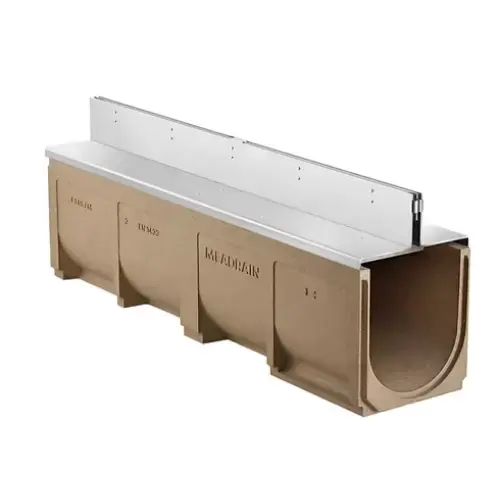
TopSlot Drainage is a slot-type surface drainage system. Water enters through a slim slot at the surface, flows through the channel underneath, and then connects into your planned drainage network.
The concept is straightforward: capture water where it lands, before it spreads. In a Waste Water Treatment Plant, that helps reduce the “wet zone” effect that often happens after washdowns or after a storm.
TopSlot systems are also flexible in layout. They can run in straight lines along walkways, wrap around building perimeters, or follow architectural boundaries where a standard grate would look messy.
• Works well along walkway edges and low points where water naturally collects
• Supports perimeter drainage around buildings to reduce splash and staining near walls
• Keeps a clean visual line in tiles or paving where you do not want a grate pattern
Choosing the Right Slot Configuration
One reason TopSlot Drainage fits modern Waste Water Treatment Plant projects is that you can match the slot style to both the site’s flow needs and the site’s visual plan. Slot position and shape can help the drainage line “disappear” into the surface.
CMSA commonly supports these practical options:
• Center Slot: a balanced look for straight walkways and symmetrical paving
• Side Slot: helps hide the opening along a curb line or tile edge
• Arc Slot: supports smooth transitions in landscaped or curved boundaries
• Multi-Slot: increases intake capacity for heavier runoff or frequent washdowns
A beginner-friendly rule is simple: choose the slot style that best matches the paving pattern, so the slot looks like a planned joint line.
Two Specs That Drive Performance: Slot Height and Cover Thickness
Many buyers think drainage selection is only about “channel size.” In real installations—especially in a Waste Water Treatment Plant—two details often decide whether the finish looks clean and stays safe over time: slot height and cover thickness.
H3: Slot Height Should Match The True Finished Level
Treatment plants often have small level differences caused by slope design, concrete tolerances, or transitions between paving and tile. If the slot sits too high, it becomes a trip edge. If it sits too low, water can pool around it instead of entering smoothly.
• Custom slot height helps align the slot opening with the finished surface
• Better alignment improves appearance, safety, and water capture efficiency
Good drainage should feel “flat and natural” underfoot. That is especially important in a Waste Water Treatment Plant where staff walk the same routes every day.
Cover Thickness Should Match Real Loading
TopSlot cover thickness commonly includes 1.2 mm, 2 mm, and 3 mm options. Thickness is not just a number—it affects stability and how well the top surface holds up in high-use areas.
If your drainage runs near service paths, equipment routes, or mixed-use zones, the cover should match the real load scenario. TopSlot systems can also be specified to meet loading classes up to D400, giving engineers room to standardize one drainage concept across the site while upgrading strength where needed.
• Stronger top surfaces reduce vibration, rocking, and long-term deformation
• Better load matching helps maintenance teams avoid repeated small repairs
Layout and Installation Tips for a Clean Finish in a Waste Water Treatment Plant
Even the best product can look wrong if the layout is careless. A clean TopSlot installation is about alignment: align the drainage line with the surface pattern, and align the slot opening with the finished ground level.
In a Waste Water Treatment Plant, we usually see three layout goals that create the most practical results:
• Keep walkways dry by placing channels along low points and edges
• Protect entrances and walls by guiding runoff away from building perimeters
• Maintain continuity in tiles or paving so the site looks clean, not patched together
Maintenance is also part of the design. TopSlot covers can be removed for inspection and cleaning access, which is useful when dirt, leaves, or site debris occasionally enter the system. Instead of complex procedures, teams can keep performance stable with routine cleaning.
A small detail that helps: plan access points so maintenance does not require breaking surrounding finishes. That is how a Waste Water Treatment Plant stays efficient—not only on day one, but after years of operation.
Common Questions and a Practical Next Step
Here are the most common questions we hear when customers specify TopSlot Drainage for a Waste Water Treatment Plant:
• Can I choose different slot position types?
Yes. Center, side, arc, and multi-slot options are available to match design and capacity needs.
• Is it suitable for heavy traffic areas?
It can be specified to D400 loading when the zone is defined correctly.
• How do I handle slot height differences across the site?
Slots are manufactured to match completed surface elevations.
• What channel widths are available?
Standard widths typically run from 100 mm to 300 mm for varied flow rates.
CTA: For new WWTP projects or walkway/edge drainage improvements, send your drawings—or a quick site sketch—to CMSA. Tell us your surface finish (paving or tile) and expected traffic level. We will recommend a practical TopSlot Drainage layout—slot type, slot height guidance, and cover thickness—so your site stays clean, safe, and easy to maintain.


