
MEA Top Slot Drainage Series for Sport Stadium
Large stadium roofs, plazas, entrances, concourses, ramps, and service roads can generate concentrated runoff within minutes. Drainage must support pedestrian safety, vehicle loading, accessibility, and architectural continuity.
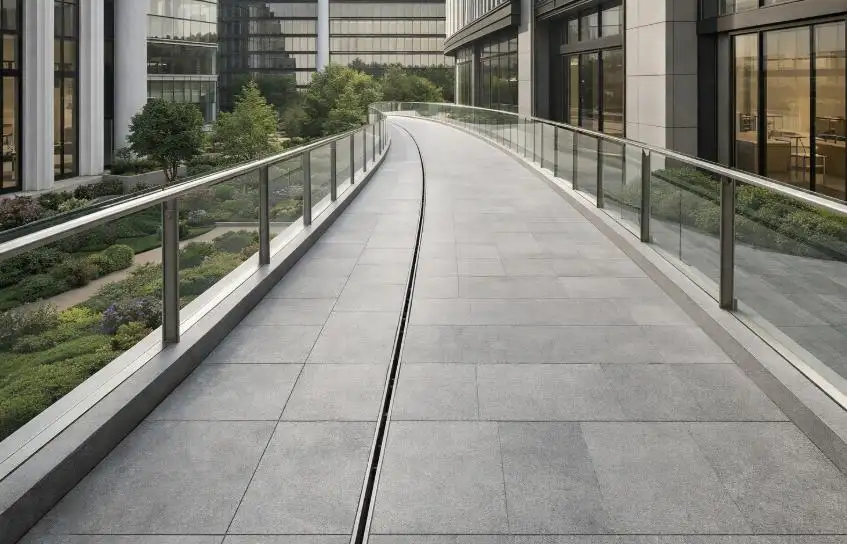
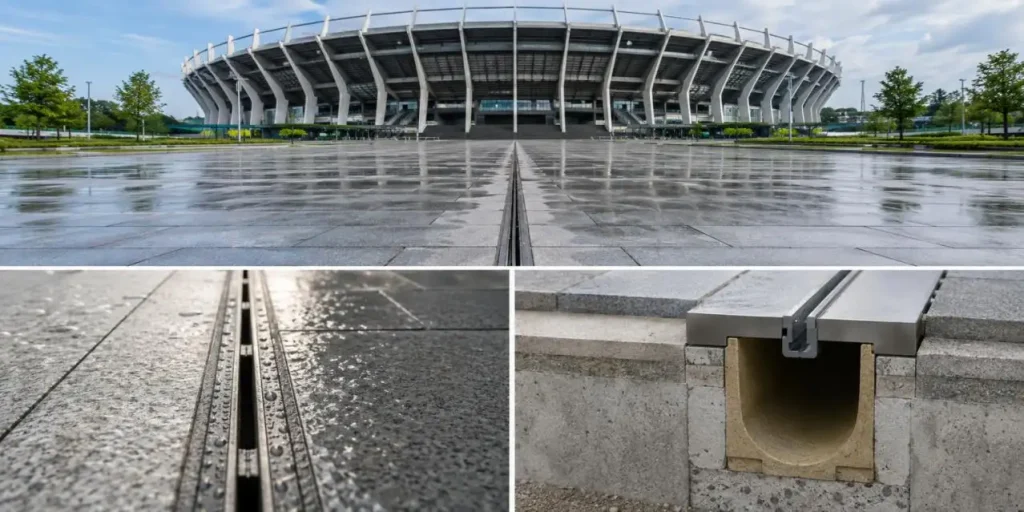
The MEA Top Slot Drainage Series for Sport Stadium captures runoff through a narrow surface slot and conveys it into a channel below. Compared with wide traditional gratings, it creates less visual interruption across stone, concrete, tiled, and landscaped finishes.
What Is the MEA Top Slot Drainage Series?
Founded in 1886 in Bavaria, Germany, MEA is a global supplier of drainage systems, basement construction solutions, and an extensive range of gratings. The MEA top slot drainage system combines a narrow surface inlet with a channel body. Water enters through the slot, moves along the channel, and discharges through outlets, catch basins, or the stormwater network.
| Specification | MEA TopSlot Options |
| Clear channel width | 100–300 mm |
| Loading class | Up to D400 |
| Slot positions | Center, side, arc, or multiple slot |
| Cover thickness | 1.2 mm, 2 mm, or 3 mm |
| Slot height | Customizable |
| Channel body height | Multiple options |
Selection should be based on hydraulic calculations, paving depth, support conditions, and loading requirements—not appearance alone.
Why Is Top Slot Drainage Suitable for Sport Stadiums?
Linear slots can follow pavement low points, entrances, stadium perimeters, concourses, and landscape boundaries. Continuous interception helps stop runoff from crossing major pedestrian routes.
A narrow slot also preserves paving continuity. Center, side, arc, and multiple-slot options can follow straight, curved, or radial stadium geometry. This makes the MEA Top Slot Drainage Series for Sport Stadium suitable for architecturally sensitive public areas.
A stadium may include pedestrian plazas, maintenance roads, emergency routes, and road interfaces. Each zone should be specified for its actual traffic conditions rather than using one loading class throughout.
Where Should Stadium Slot Drainage Be Installed?
| Stadium Area | Main Purpose | Key Concern |
| Main entrances | Stop runoff entering buildings | Safety |
| Stadium perimeter | Collect pavement runoff | Outlet spacing |
| Public plazas | Drain large paved areas | Peak flow |
| Concourse areas | Protect circulation routes | Slip risk |
| Landscape boundaries | Separate planted and paved zones | Debris |
| Service roads | Manage vehicle runoff | Loading class |
| Roof discharge points | Receive concentrated flow | Inlet capacity |
Channels should follow hydraulic low points, not simply the building edge.
How to Evaluate the Hydraulic Capacity?
The catchment should be categorized as roof, plaza, concourse, ramp, landscaped paving, and service paving. Peak runoff can be calculated using the formula:
Q = C × I × A
Where Q refers to design runoff; C, the runoff coefficient; I, the rainfall intensity; and A, the catchment area. Final calculations need to be based on the local rainfall data and the local drainage design standards.
Additionally, engineers need to assess the following:
•Slot inlet area and quantity
•Surface crossfall and flow direction
•Debris and downpipe discharge
•Channel length and capacity
•Outlet number, size, and spacing
•Downstream pipe capacity
Hydraulic assessment when considering the MEA Top Slot Drainage Series for Sport Stadium is critical. A large channel will not eliminate ponding if the inlet or outlet system is undersized.
Selecting Channel Width and Body Height
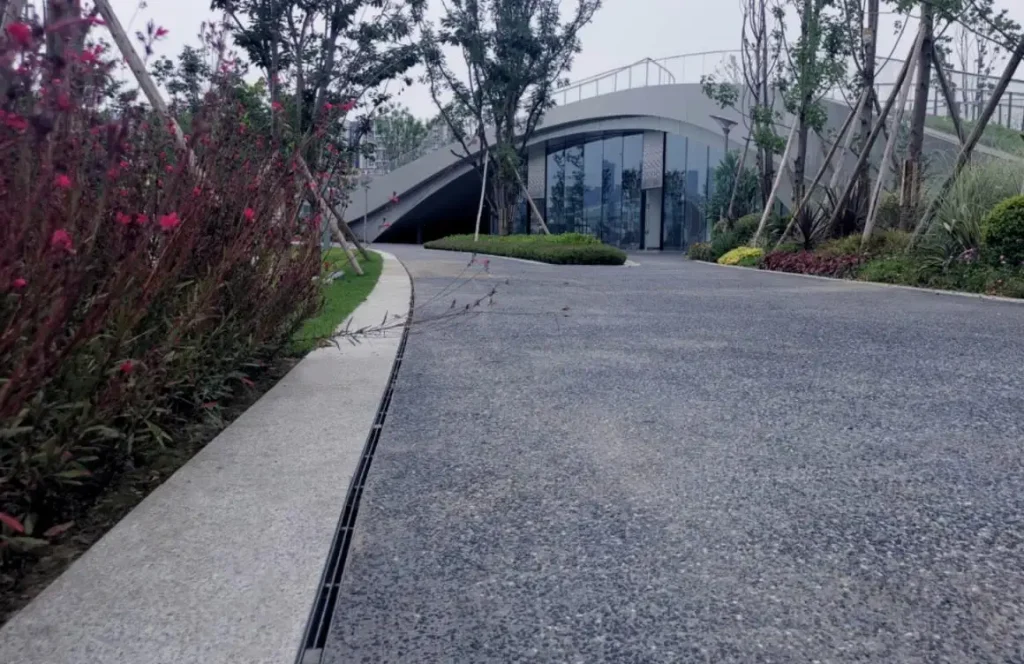
MEA TopSlot is compatible with clear channel widths from 100 mm to 300 mm and multiple body heights. Selection depends on peak runoff, channel length, installation depth, slope, outlet spacing, sediment exposure, and maintenance access.
Widened channels become problematic. An appropriate channel is the result of an optimal balance of capacity, depth, support, maintenance, and cost.
Choosing Slot Configuration
| Slot Type | Typical Usage | Primary Benefit |
| Center slot | Entrances and plazas | Uniform appearance |
| Side slot | Along edges of walls and landscaped areas | Boundary merging |
| Arc slot | Along edges of curved stadiums | Compatible with the site |
| Multiple slot | Locations with considerable inflow | Added inlet room |
It is necessary to maintain the same height for slots and paving with respect to waterproofing, finishes, and the layers in between. The cover thickness of 1.2 mm, 2 mm, or 3 mm is available to be evaluated with respect to the loading class, the supports, and how the slots will be installed.
Loading Class Overview
To a maximum of D400, MEA TopSlot supports all classes, yet D400 is not warranted in all locations.
•Safe surface integration is the priority in pedestrian plazas.
•Utility maintenance vehicle passage may be required.
•Heavy-duty configurations may be required for emergency access.
The engineer is responsible for designating the appropriate class.
Installation Concepts
Successful installation of MEA Top Slot Drainage Series for Sport Stadium requires:
- Prior the completion of paving and subsurface work coordination of drainage.
- Precision in the setting of channel and slot elevation.
- Stable support and foundation.
- Formation of a surface slope toward the slot.
- Coordinated drainage elements.
- Prior to handover, alignment and access checks, along with sealing and flow checks, must be completed.
Maintenance and Common Errors
Mistakenly referred to as maintenance free, Top Slot drainage systems require the following maintenance. During routine maintenance, leaves and sediment should be removed, slots and outlets should be inspected, and catch basins should be cleaned prior to and following major events.
Some common errors include: making selections based on appearance alone; failing to account for peak runoff; providing inadequate outlets; applying a single loading class; mismatch of paving and slots; use of a poor quality base; and failure to provide access for cleaning.
Final Recommendations
The full water management system at a sport stadium requires use of the MEA Top Slot Drainage Series. It includes assessment of surface inlet capacity, channel conveyance, outlet discharge, paving, loading, and maintenance access. This system is flexible in design and allows for varied stadium zones.
Planning a Sport Stadium Drainage Layout?
CMSA, the sole distributor of MEA solutions in Southeast Asia, has been in business since 2000. CMSA assists in the specification of the MEA Top Slot Drainage Series for Sport Stadium, for architects, engineers, and contractors. Contact CMSA with your layout, catchment area, design flow, paving depth, loading class, and preferred slot configuration to facilitate the TopSlot specification.
FAQs
Q1. What is the MEA Top Slot Drainage Series for Sport Stadium?
MEA (Germany) configured a drainage system that utilizes a connecting linear channel to a narrow surface slot. This system provides an unobtrusive, continuous collection line for the drainage of rainwater around stadium facilities.
Q2. Does CMSA supply MEA TopSlot drainage systems?
CMSA is the exclusive supplier of MEA solutions in Southeast Asia and offers assistance to project teams for the selection and specification of drainage products.
Q3. Where in a stadium can MEA TopSlot drainage be installed?
They can be installed in a variety of locations such as entrance plazas, the stadium perimeter and concourses, various pedestrian and service routed pathways, as well as in landscaped areas and roof discharge locations.
Q4. What channel widths can CMSA supply?
CMSA can supply the MEA Top Slot Drainage Series for Sport Stadium in clear channel widths ranging from 100 mm to 300 mm.
Q5. Can CMSA customize the TopSlot position?
Yes. CMSA can supply center slot, side slot, arc slot and various multiple slot configurations to accommodate different designs and layouts of paving and to meet varying architectural needs.


